P1S
ABS/ASA capableFully enclosed, sealed, with activated carbon filtration. The P1S is where Bambu's lineup gets serious about engineering materials: Bambu rates ABS and ASA as ideal in the enclosure, PA and PC as capable.
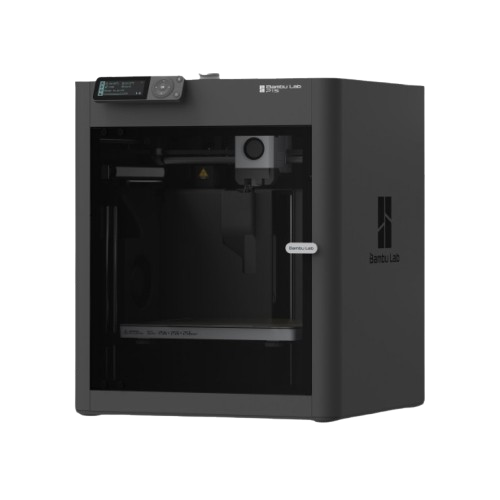
Image: Bambu Lab.
Should I buy the P1S?
At $369: yes, it is the cheapest enclosed Bambu, $180 under the P2S. The P2S ($549) is newer and faster; the P1S is the cheaper way in. If $180 does not matter to you, the P2S is the better machine.
Who should buy the P1S?
- ABS and ASAGood fit
The enclosure and the 100°C bed make ABS and ASA practical; the chamber is passive, not actively heated. P1S vs P2S → - Carbon and glass fiberDepends
Bambu says to fit a hardened steel hotend and extruder gear before printing fiber-reinforced filament on the P1S; the P2S ships with a hardened steel nozzle. P1S vs P2S → (Bambu P1 FAQ) - MulticolorGood fit
Full AMS support, up to 16 colors. A1 vs P1S → - Upgrading from the A1Good fit
Same 256 × 256 × 256 mm build volume, plus an enclosure for ABS and ASA, which Bambu rates as not recommended on the A1. A1 vs P1S → (Bambu A1 specs)
Known issues
- Fiber-filled filament: Bambu advises against carbon or glass fiber on the stock hotend until a hardened steel hotend and a hardened steel extruder gear are fitted. (Bambu P1 FAQ)
- Bambu Studio keeps the print height at 250 mm and blocks an 18 × 28 mm area in the front left corner for the filament cutter by default; the full 256 mm cube needs a stopper change and works only without the AMS. (Bambu wiki)
- Printers on firmware below 01.09.01.00 must first install the 01.09.01.00 bridge firmware by offline update before any newer version. (Bambu release notes)
Known issues only from Bambu's own wiki, firmware release notes, FAQ, blog and recall pages, checked October 2, 2026. Specs: our table below and Bambu's spec pages.
| Motion & Print | |
|---|---|
| Build volume | 256 × 256 × 256 mm (10.1 × 10.1 × 10.1 in) |
| Max speed | 500 mm/s |
| Acceleration | 20,000 mm/s² |
| Motion system | CoreXY |
| Layer height (0.4 mm nozzle) | 0.08–0.28 mm (Bambu Studio default range) |
| Extruder | Direct drive |
| Nozzle (stock) | 0.4mm |
| Temperature & Enclosure | |
|---|---|
| Nozzle max | 300°C |
| Bed max | 100°C |
| Enclosure | Yes |
| Chamber heating | Passive, not heated (chamber regulator fan) |
| Air filter | Activated carbon (no HEPA) |
| Carbon filter | Yes |
| Bed surface | Textured PEI (magnetic) |
| Auto leveling | Yes |
| Vibration comp. | Yes |
| Camera | Yes (included) |
| AMS | AMS compatible (up to 4 units, 16 colors) |
| Display | 2.7" LCD (button controls) |
| Connectivity | Wi-Fi 2.4GHz, LAN |
| Machine dimensions | 389 × 389 × 458 mm |
| Weight | 12.95 kg |
| Power supply | 100–240V AC, max 1000W at 220V / 350W at 110V |
The P1S is a solid machine that established Bambu's credibility in the enclosed-printer market. The fully sealed enclosure, combined with the 100°C bed, makes ABS and ASA genuinely reliable. Bambu rates PA and PC as capable and advises against fiber-filled filament on the stock stainless nozzle. The camera is included, so you can monitor prints remotely.
The honest math changed in 2026: the P1S sells for $369, well under the $699 it launched at, which makes it $180 cheaper than the P2S instead of $150 more expensive. The P2S ($549) is still the better machine, faster at 600 mm/s with an improved motion system. But at current prices the P1S is the budget pick, not the overpriced one.
Pros
- Fully sealed enclosure: reliable ABS/ASA printing
- Activated carbon filter against odors and fumes (no HEPA stage)
- 100°C bed: enough for ABS and ASA
- AMS compatible, up to 16 colors
- Camera included for remote monitoring
- Proven, well-documented platform
- Large community and third-party support
Cons
- You want the newer machine: the P2S ($549) is faster, but $180 more at current prices
- Stock stainless nozzle: no fiber-filled filament without a hardened upgrade; PA and PC only rated capable
- Passive chamber only, no active heating
- 500 mm/s max (P2S does 600 mm/s)
- No Lidar first-layer scanning
- AMS sold separately (from $249)
| Material | Support | Notes |
|---|---|---|
| PLA / PLA+ | Excellent | Works perfectly. |
| PETG | Excellent | Use glue stick on PEI. Seal chamber first for best results. |
| ABS | Excellent | Enclosure makes this reliable. Pre-heat chamber for 15 min. |
| ASA | Excellent | ASA is actually easier than ABS. Great results. |
| TPU | Supported | Direct drive handles TPU well. |
| PA / PA6 | Capable | Bambu's rating for PA on the P1S. Needs dry filament and a pre-heated chamber. Glass-filled PA-GF also needs a hardened nozzle. |
| PLA-CF / PETG-CF | Not recommended (stock) | Bambu advises against fiber-filled filament on the P1S until extruder and hotend are upgraded to hardened parts. |
| PC (Polycarbonate) | Capable | Bambu's rating for the P1S. No active chamber heating; an actively heated chamber (X2D, H2S) reduces warping on large PC parts. |
| PA-CF (high-temp) | Not recommended | Fiber-filled, so Bambu advises against it on the stock nozzle. Use a printer with a hardened nozzle (P2S, X2D, H2S); an active chamber helps. |
ABS/ASA pre-heat: Before starting a print, heat the bed to 100°C and let the chamber reach temperature for 15–20 minutes. This prevents corner lifting dramatically.
LAN mode: Enable LAN Only + Developer Mode in Settings for Orca Slicer. Use the local IP and access code.
Filter maintenance: Replace the activated carbon filter periodically. Bambu recommends every 3 months with regular use. Clogged filters reduce effectiveness.
P1S or P2S? P2S if the $180 difference does not matter to you: it is the newer machine and faster (600 vs 500 mm/s). The P1S is the cheaper one, $369 vs $549 in the Bambu US store (checked October 6, 2026), which makes it the budget pick and the P2S the performance pick.
P1S or X1C? The X1C added Lidar first-layer scanning and AI failure detection, but it is discontinued; its successor is the X2D at $649. If print consistency on long, complex jobs matters, the X2D is the upgrade to consider. Otherwise the P1S (or P2S) is sufficient.
Does the AMS work with the P1S? Yes, the full AMS (not AMS Lite). Up to 4 AMS units, 16 colors per print. AMS is sold separately ($249 for the original AMS, $299 for the AMS 2 Pro in the Bambu US store, checked October 7, 2026); in a combo it adds $130 (P1S AMS Combo $499) or $210 (P1S AMS 2 Pro Combo $579).
Is the passive chamber enough for PA? Bambu rates PA as capable (not ideal) on the P1S, so plain PA works with dry filament and a pre-heated chamber. Glass- and carbon-filled grades are not recommended on the stock stainless nozzle; for PA-CF, a printer with a hardened nozzle and an actively heated chamber (X2D, H2S) is the better fit.
Starter accessories for the P1S
What we would add to a new P1S in the first month.

Same 257 mm format as the stock P1S plate at a lower price. A spare plate means back-to-back prints.
Amazon →
Drop-in hardened high-flow nozzle for the P1S. Higher throughput, and it survives abrasive CF filament.
Amazon →
Capricorn XS, 1.9 mm ID. Bambu specifies 2.0 mm ID tubes for the P1S and inside the AMS units and advises against a smaller ID because it adds friction. In our own printers it has still worked better than the stock tube, which is why we keep recommending it; if feeding gets worse, go back to the stock size.
Amazon →
The P1S enclosure does not protect filament from moisture. Drying PETG and nylon fixes stringing at the source.
Amazon →Affiliate links. We may earn a commission at no extra cost to you.