H2D
FlagshipBambu's current flagship. Two switching nozzles in one toolhead for true multi-material printing, 350°C, active 65°C chamber, and an optional laser module for engraving and cutting. Nothing else in the consumer space does all of this.

Image: Bambu Lab.
Should I buy the H2D?
Yes, if you specifically need dual-nozzle printing, soluble supports, true multi-material parts or the higher-power 40W laser. Otherwise the H2S ($1,199) does the same engineering-grade printing, and takes the same optional 10W laser and cutting module, for $350 less at current street prices ($500 at typical prices).
Who should buy the H2D?
- Soluble supports and two materialsGood fit
Two nozzles on one toolhead take turns, so model and support material each keep their own nozzle; only one prints at a time. H2S vs H2D → (Bambu wiki) - One material at a timeDepends
The H2S has the same 350°C hotend and 65°C heated chamber with a single nozzle. H2S vs H2D → - Laser engraving and cuttingGood fit
Takes the 10W or the 40W laser module plus the cutting module; the H2S is limited to the 10W laser. H2S vs H2D → (Bambu store) - Many colorsGood fit
Up to 25 colors with AMS 2 Pro and AMS HT units; since firmware 01.04.00.00 the optional Filament Track Switch maps AMS feeds to both nozzles. H2D vs H2C → (Bambu wiki)
Known issues
- PTFE tube detachment detection is temporarily disabled; Bambu lists it as a known issue of the current firmware 01.04.00.00. (Bambu release notes)
- Firmware 01.04.00.00 changed the compensation for circular holes; Bambu advises finishing multi-part projects before updating, because parts printed before and after may not fit together. (Bambu release notes)
- A build plate that is not seated against the rear alignment tabs can hit the purge wiper while the bed homes, and a nozzle wiper pad that sits too high can strike the nozzle; Bambu's fix is to seat the plate against the tabs and press the wiper pad fully into its holder. (Bambu wiki)
Known issues only from Bambu's own wiki, firmware release notes, FAQ, blog and recall pages, checked October 2, 2026. Specs: our table below and Bambu's spec pages.
| Motion & Print | |
|---|---|
| Build volume | 325 × 320 × 325 mm single nozzle (12.8 × 12.6 × 12.8 in); 300 × 320 × 320 mm dual nozzle; 350 × 320 × 320 mm total across both nozzles |
| Max speed | 1,000 mm/s |
| Acceleration | 20,000 mm/s² |
| Motion system | CoreXY (H-series) |
| Layer height (0.4 mm nozzle) | 0.08–0.28 mm (Bambu Studio default range) |
| Extruder | Direct drive, one extrusion motor for both nozzles (switching) |
| Nozzle count | 2 (one toolhead, switching) |
| Nozzle (stock) | 0.4mm × 2, hardened steel |
| Temperature & Enclosure | |
|---|---|
| Nozzle max (each) | 350°C |
| Bed max | 120°C |
| Enclosure | Yes |
| Chamber heating | Active (65°C) |
| Air filter | 3-stage: G3 pre-filter + H12 HEPA + carbon |
| Carbon filter | Yes |
| Bed surface | PEI (magnetic, high-temp) |
| Auto leveling | Yes (both nozzles) |
| Vibration comp. | Yes |
| Flow calibration | Yes (per nozzle) |
| Lidar sensor | No (Micro Lidar only in the laser module, for Z height) |
| Camera | Yes (included) |
| AMS | AMS 2 Pro / AMS HT (up to 25 colors) + dual nozzle |
| Laser + cut module | Optional (10W or 40W, sold separately) |
| Connectivity | Dual-band Wi-Fi (2.4 + 5 GHz), LAN mode |
| Machine dimensions | 492 × 514 × 626 mm |
| Weight | 31 kg |
| Power supply | 100–120V or 200–240V AC (regional versions), max 2200W at 220V / 1320W at 110V |
| Status | Current (Apr 2025) |
The H2D is Bambu's most capable machine and genuinely unique in the consumer-prosumer space. The dual-nozzle switching system is not a gimmick: two nozzles on one toolhead take turns, so model material and soluble support, or two different mechanical materials, each run through their own nozzle instead of being purged through one. This is fundamentally different from AMS-style multi-color (which is one nozzle swapping filaments).
At $1,549 you need to be using the dual nozzle or the 40W laser to justify it over the H2S at $1,199. For single-material engineering parts, even in PA-CF, the H2S does that for $350 less at current street prices ($500 at typical prices), and it takes the same optional 10W laser and cutting module. The H2D earns its price when the dual nozzle is doing real work: soluble supports and true multi-material parts, plus 40W-laser support.
Pros
- True dual-material printing (unique capability)
- 350°C hotend × 2, covering the full engineering material range
- 65°C active heated chamber
- 1,000 mm/s print speed
- Large 325 × 320 × 325 mm build volume
- Optional laser engraving/cutting module (10W or 40W)
- Soluble support capability (PVA, BVOH)
Cons
- $1,549 at current street price ($1,749 typical price), only justified if the dual nozzle or 40W laser is genuinely used
- 31 kg, heavy and not easily moved
- Dual nozzle calibration requires initial setup time
- Laser module is an additional purchase
- Up to 2,200W draw at 220V (1,320W at 110V)
- AMS 2 Pro / AMS HT sold separately
Same hotend and chamber capabilities as the H2S. Both nozzles are rated the same.
| Material | Support | Notes |
|---|---|---|
| PLA / PLA+ | Works | Fine, though overkill. |
| PETG | Works | Fine. |
| ABS / ASA | Excellent | Active chamber = very reliable. |
| PA-CF / PA12-CF | Excellent | Target material. Excellent results. |
| PC / PC-CF | Supported | 350°C + active chamber handles PC. |
| HIPS (support) | Not listed | Not on Bambu's H2D filament list; PVA and BVOH are. Test before relying on it. |
| PVA (support) | Supported | Water-soluble supports. Works well in the enclosed chamber. |
| TPU | Supported | Useful for dual-material flexible parts. |
| PEEK | Not listed | Not on Bambu's H2D filament list. Check the filament maker's specs before trying. |
Dual nozzle calibration: Before your first dual-material print, run the XY nozzle offset calibration. Small offsets between the two nozzles cause visible layer misalignment. This is a one-time setup but takes 20–30 minutes to do properly.
Soluble supports: PVA and BVOH are the water-soluble supports on Bambu's H2D filament list. Match the support material temperature range to your model material.
Laser mode: Switching between print and laser means mounting the laser module onto the toolhead (front cover off, slide the module on, lock the quick-release lever, plug in the cable and air-assist tube) and swapping the build plate for the laser platform, so plan for a few minutes. Always use appropriate eye protection; do not rely on the enclosure door as a laser shield.
Pre-heat: Same as H2S, set chamber to 65°C and let it reach temperature and stabilize before engineering material prints.
H2D or H2S? H2S ($1,199) if you print single-material engineering parts or use AMS for multi-color. H2D ($1,549) if you need the dual nozzle (two materials in one print, switching between two nozzles) or the higher-power 40W laser. Both take the optional 10W laser and cutting module.
What's dual nozzle vs AMS? AMS swaps one nozzle between filaments (with purge). The H2D's dual-nozzle switching system carries two nozzles on one toolhead and switches between them, so two materials each keep their own nozzle instead of being purged through one. The nozzles take turns; they do not print at the same time.
Is the laser module worth it? If you'd use it, yes. The H2D takes a 10W or 40W diode laser in an enclosed, filtered chamber. Not a replacement for a dedicated laser cutter, but useful for engraving and light cutting. Priced separately, so evaluate based on your actual use case.
Can you use one nozzle only? Yes. For single-material printing, the H2D acts like any high-temp machine with the second nozzle parked. No quality or speed penalty.
Links to the Bambu Lab store and Amazon are affiliate links. We may earn a commission at no extra cost to you.
Starter accessories for the H2D
What we would add to a new H2D in the first month.

PA, PC, and the other materials the H2D is made for are hygroscopic. A dryer prevents foamy, brittle prints.
Amazon →Carbon-fiber PC (use the PC profile) suited to the H2D's 350°C hotend and hardened extruder. Stiff parts with low warp.
Amazon →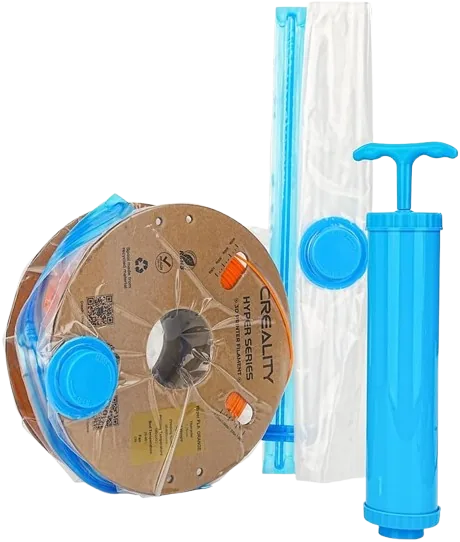
Engineering filament left in open air is ruined in days. Vacuum-seal opened spools between H2D print runs.
Amazon →
Capricorn XS, 1.9 mm ID. Bambu specifies 2.5 mm ID tubes for the H2D (2.0 mm inside the AMS units) and advises against a smaller ID because it adds friction. In our own printers it has still worked better than the stock tube, which is why we keep recommending it; if feeding gets worse, go back to the stock size.
Amazon →Affiliate links. We may earn a commission at no extra cost to you.