H3C
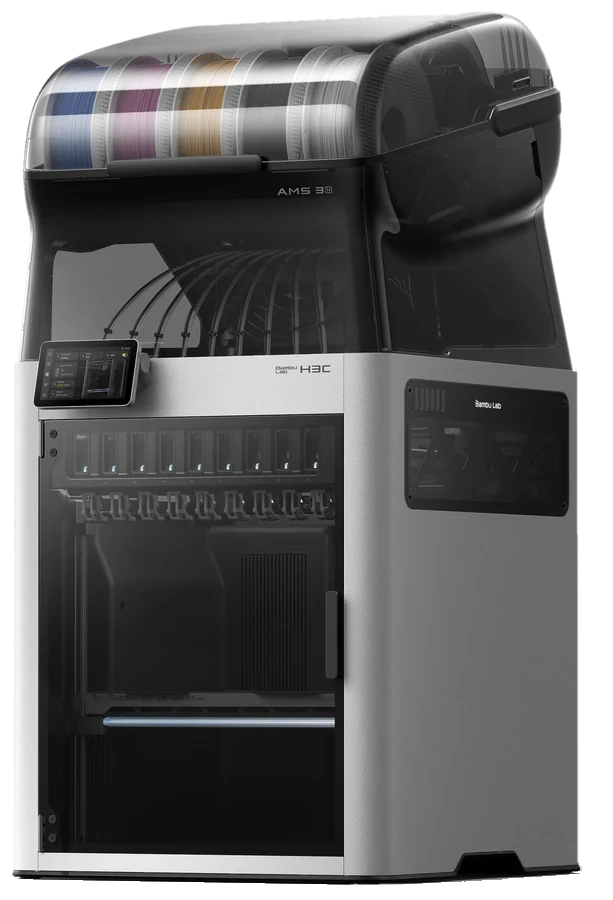
Bambu's tool changer: nine PrintTools, each with its own heater and filament path, wait loaded and preheated in a rack and swap onto the toolhead in 3.4 seconds by Bambu's figure. The nine-slot AMS 3H sits on top as part of the printer, and one tool takes 2.85 mm filament for soft TPU. Revealed and on sale since November 3, 2026.
Orderable in Bambu's US store since November 3, 2026; the store says orders ship from its US warehouse within 1 to 3 business days once processed. Sold only with the AMS 3H: H3C Combo $2,499, with a filament starter pack $2,589, with the Bambu Station L stand $2,799, checked November 3, 2026. Specs below are from Bambu's H3C spec page, checked November 3, 2026.
What's the H3C?
A tool changer for multi-material printing. Each of its nine PrintTools has its own heater, cutter and filament path; Bambu's FlexFeed extruder on the toolhead feeds whichever tool is docked, 1.75 mm or 2.85 mm. Nine spools feed from the built-in AMS 3H, up to 24 with existing AMS units and a separately sold buffer.
Store price and the 90-day low
Official Bambu Lab US store, checked November 3, 2026.
| Configuration | US store price |
|---|---|
| H3C | $2,499 |
| H3C Combo | $2,499 |
| 90-day low, H3CNo lower price in the last 90 days | $2,499 |
The 90-day low is the lowest price in our daily log of the US store, Aug 7 to Nov 4, 2026.
Confirmed specs
- Isometric view.
- Source: Bambu spec page bambulab.com/en-us/h3c/specs, checked 2026-11-03
| Build volume | 330 × 320 × 325 mm (13 × 12.6 × 12.8 in) |
|---|---|
| Max speed | 1,400 mm/s |
| Tool system | SwapTek: 9 PrintTools, each with its own heater, cutter and filament path; 3.4 s per tool change, 6 s per material switch (Bambu) |
| Max materials / colors | 9 from the AMS 3H; up to 24 spools with existing AMS units on PrintTool No. 1, through the Buffer for External AMS ($24.99, sold separately) |
| Filament diameter | 1.75 mm; 2.85 mm for flexible filament on the included 2.85 mm PrintTool (bypass feed, ships in slot 8) |
| Nozzle sizes | 0.2, 0.4, 0.6 and 0.8 mm (0.4 mm included); different sizes in one print |
| Hardened parts | Extruder gear and every nozzle in hardened steel, HRC 55+ by Bambu's FAQ |
| Max nozzle temp | 350°C |
| Max bed temp | 120°C |
| Chamber | Active (65°C) |
| Enclosure | Yes (H11 HEPA + carbon) |
| Price | $2,499 (H3C Combo with AMS 3H, no discount at launch; checked November 3, 2026) |
| Weight / size | 36.28 kg including the AMS 3H; 493 × 571 × 587 mm without, 493 × 571 × 1016 mm with the AMS 3H |
| AMS support | AMS 3H built in (9 slots, 2 of them dry at up to 85°C); up to 4 AMS, AMS 2 Pro or AMS HT units connect through PrintTool No. 1 with the Buffer for External AMS, not included |
| Wi-Fi | Wi-Fi 6, 2.4 and 5 GHz; no Ethernet |
| Announced / shipping | Revealed and on sale November 3, 2026; the US store ships within 1 to 3 business days |
Who should buy the H3C?
Many materials in one printGood fit
Nine PrintTools stay loaded and preheated in the rack, and Bambu puts a material switch at as little as 6 seconds. H2C vs H3C (Bambu H3C page)
Soft TPUGood fit
The included 2.85 mm PrintTool takes TPU as soft as 75A, at up to 3× the flow rate of traditional printers by Bambu's figure. H3C explained (Bambu H3C page)
Two materials onlyDepends
If two nozzles cover your work, the H2D does it with two switching nozzles. H2D vs H3C
One material at a timeLook elsewhere
The H2S has a 350°C hotend and a 65°C heated chamber with a single nozzle. H2S
Known issues
- No Ethernet port: Bambu's spec page lists Ethernet, a network kill switch and 802.1X as not available. (Bambu H3C specs)
- The 2.85 mm PrintTool is for flexible filament only, and 1.75 mm and 2.85 mm bases and hotends are not interchangeable; nine 1.75 mm colors need an extra 1.75 mm PrintTool. (Bambu H3C FAQ)
- The AMS 3H dries two slots at a time, up to 85°C. (Bambu H3C FAQ)
Known issues only from Bambu's own wiki, firmware release notes, FAQ, blog and recall pages, checked November 3, 2026. Specs: our table above and Bambu's spec pages.
H3C trade-offs
Nine tools that stay loaded make material switches fast. Bambu's own FAQ and wiki also spell out where that design sets limits:
- Extra AMS units run through one tool. Beyond the nine spools in the AMS 3H, the H3C takes up to four AMS, AMS 2 Pro or AMS HT units, and only on PrintTool No. 1. They connect through the Buffer for External AMS, which is not in the box: $24.99 in Bambu's US store, and buffers from earlier Bambu printers don't fit. Several units also need Bambu's 4-in-1 PTFE adapter II. Spools beyond the nine tools share that one filament path, so changes between them purge and waste more filament than a tool switch. (Bambu H3C wiki FAQ, multi-AMS guide)
- Two drying slots. The AMS 3H dries slots 6 and 8 at up to 85°C; the other seven slots are sealed but not dried. For more drying, Bambu points to extra AMS 2 Pro or AMS HT units on the buffer, and on the H3C an AMS 2 Pro dries only on its own power adapter, because the printer does not power its dryer. (Bambu H3C wiki FAQ)
- PLA next to engineering filament in the dryer. Slots 6 and 8 share one drying chamber. If both hold filament for the same print, the drying temperature has to suit the more heat-sensitive one: Bambu's PVA guide sets 55°C when PLA shares the chamber, because PLA softens above that and can jam the extruder, while the dryer reaches 85°C for PA and PC. Bambu also limits drying while printing to filaments that stay dimensionally stable at drying temperature. (Bambu H3C PVA guide, Bambu H3C page)
- Each spool prints through its own tool. Every AMS 3H slot has its own path to one PrintTool, so a filament prints with that tool's nozzle size, and mixing sizes means buying extra hotends. Bambu says the H2C's automatic pairing of any filament with any nozzle size is something the H3C doesn't replicate, and calls the H2C especially valuable for engineering materials and shared printers. H2C vs H3C (Bambu US store, H3C FAQ)
- Unloading is hands-on. To swap a spool, you unload it on the screen and turn the spool by hand to wind the filament back, as Bambu's first-print guide describes. (Bambu H3C first print)
From Bambu's H3C FAQ, wiki and store pages, read November 4, 2026; not tested by us.
How does the H3C swap tools?
Bambu's SwapTek rack holds nine PrintTools. Each has its own heater, cutter and filament path, so every material stays loaded, and Active Pre-Heat warms the next tool while the current one prints. Bambu gives 3.4 seconds per tool change and 6 seconds per material switch. The H2C, Bambu's previous multi-material printer, swaps only hotends: one fixed hotend plus six induction-heated hotends from its Vortek rack.
Swapping is not waste-free. Bambu advertises 0.038 g of purge per change; CNC Kitchen, after almost 400 hours on a test unit from Bambu, measured about 50 mg on the prime tower per change, close to 200 g on a print with more than 4,000 changes. A material switch took 6 to 7 seconds in that test, a little over 10 seconds when the tool also printed the tower's outer wall.
One of the nine tools takes 2.85 mm filament. Bambu's TPU 75A in that size costs $28.79 in its US store and works with none of the AMS, AMS lite, AMS 2 Pro or AMS HT; it feeds through the bypass. Bambu says the FlexFeed extruder prints TPU this soft at up to 3× the flow rate of traditional printers.
H3C vs H2C
| H3C | H2C | |
|---|---|---|
| Price | $2,499 (Combo with AMS 3H) | $1,899 (AMS Combo) |
| What swaps | PrintTools, 9: hotend with its own heater, cutter and filament path | Hotends: 6 swappable from the Vortek rack plus 1 fixed |
| Materials per job | 9 loaded tools; up to 24 spools with extra AMS units | 7 melt zones; up to 25 colors with AMS units |
| Build volume | 330 × 320 × 325 mm | 305 × 320 × 325 mm (right nozzle) |
| Max speed | 1,400 mm/s | 1,000 mm/s |
| Max nozzle temp | 350°C | 350°C |
| Chamber | Active (65°C) | Active (65°C) |
| Filament | 1.75 mm, plus 2.85 mm on one tool | 1.75 mm |
Both are sold only with an AMS, so the $600 gap compares complete systems. Full comparisons: H2C vs H3C and H2D vs H3C.
What we don't know yet
- Long-term wear of the tool docks and PrintTools over thousands of swaps
- When Bambu publishes the first H3C firmware release notes; its wiki page says coming soon
- Which 2.85 mm materials follow TPU 75A, and when; Bambu's FAQ only says more flexible ones are on the way
We'll update as data comes in. News
Compare
Related reading
- Bambu Studio 2.9.1: Mixed Nozzle Sizes, Betas Go StableBambu Studio 2.9.1 is the first stable release since August: mixed nozzle sizes for the H3C, the 2.8.3 and 2.8.4 beta...
- Bambu Lab H3C: Specs, Price, Nine-Tool ChangerBambu revealed the H3C on November 3: nine tools, 330 × 320 × 325 mm build volume, $2,499 in the US store. Specs...
- Bambu FCC Filings: H3C, P3C, X2D Pro, S1 ScannerSeven Bambu devices passed the FCC in September 2026: H3C, P3C, X2D Pro, AMS 3H and 3P, the R1 and an S1 3D scanner....
- Bambu's Nine-Bay Patent Is Not a ToolchangerA Bambu patent shows a rack of nine hotends. Reported as a toolchanger, but the drawings show the extruder stays on the...
Sources
15 sources, including Bambu Lab product pages and store, Bambu Lab wiki, Bambu Lab forum and CNC Kitchen. Last checked November 4, 2026.
ShowHide
- Bambu Lab US, H3C pagebambulab.com/en-us/h3cSwapTek, Active Pre-Heat, FlexFeed and AMS 3H, read November 3, 2026
- Bambu Lab US store, H3Cus.store.bambulab.com/en/products/h3cCombo prices, shipping and warranty, checked November 3, 2026; FAQ on external AMS and the H2C, read November 4, 2026
- Bambu Lab US store, Buffer for External AMS - H3Cus.store.bambulab.com/products/buffer-for-external-ams-h3cPrice, not included as standard, contents, checked November 4, 2026
- Bambu Lab H3C specsbambulab.com/en-us/h3c/specsSpecifications, checked November 3, 2026
- Bambu Lab H3C FAQbambulab.com/en-us/h3c/faqPrintTools, dimensions and the AMS 3H dryer, read November 3, 2026
- Bambu Lab Wiki, H3C FAQwiki.bambulab.com/en/h3c/manual/faqExternal AMS on PrintTool 1, the buffer, drying slots 6 and 8, power for AMS 2 Pro drying, read November 4, 2026
- Bambu Lab Wiki, connecting multiple AMS units to the H3Cwiki.bambulab.com/en/h3c/manual/ams-connection-guideUp to four AMS units, required parts, why only PrintTool 1, read November 4, 2026
- Bambu Lab Wiki, H3C PVA printing guidewiki.bambulab.com/en/h3c/manual/pva-printing-guideDrying temperature when filaments share the drying chamber, read November 4, 2026
- Bambu Lab Wiki, H3C first printwiki.bambulab.com/en/h3c/manual/first-printLoading and unloading filament, read November 4, 2026
- Bambu Lab Wiki, H3C main componentswiki.bambulab.com/en/h3c/manual/main-componentsCoreXY motion system; the wiki's H3C firmware page says coming soon, read November 3, 2026
- CNC Kitchen, “Bambu Lab Finally Built the Toolchanger We Wanted!”youtube.com/watch?v=V3X8Xe5W04gTest after almost 400 print hours on a unit from Bambu: purge per change and switch times, published November 3, 2026
- Bambu Lab forum, "[Bambu Lab H3C] Nine tools in one printer"forum.bambulab.com/t/261448Posted October 23, 2026; the four teasers that followed: TPU 75A, Your print, 0.2 or 0.4, HRC 55+
- Bambu Lab US store, TPU 75A (2.85mm)us.store.bambulab.com/products/tpu-75a-2-85mmPrice and compatibility, checked November 3, 2026
- Bambu Lab H2C tech specsbambulab.com/en-us/h2c/specsH2C build volume and filament diameter for the comparison, checked October 2, 2026
- BambuHub daily store logbambuhub.net/bambu-price-trackingOur daily check of the US store
What changed
Newest first, from this page's version history. Only changes to text you can read here; date refreshes and reshuffled reading links are left out.
- Added an H3C trade-offs section from Bambu's FAQ and wiki: extra AMS units run only through PrintTool No. 1 and need the separately sold Buffer for External AMS, two drying slots, PLA in the shared drying chamber, one nozzle per spool, unloading by hand. The H2C comparison row now also counts its AMS colors.
- Published.
- Model
- H3C
- Page
- Type
- Shipping
- Last updated
- Editor
- BambuHub editorial
- Sources
- Listed above
- Status
- Not affiliated with Bambu Lab