H2C
ShippingDual-hotend H-series printer plus the Vortek rack: 6 swappable induction hotends next to 1 fixed hotend give one job 7 dedicated melt zones and up to 25 colors, with minimal purge waste. Announced at Formnext November 2025, shipping in the US and EU stores since.

Image: Bambu Lab.
The H2C sells in Bambu's US and EU stores (our price tracker logs it daily: $2,199). Specs below are from Bambu's official wiki documentation (checked July 20, 2026); build volume, weight and size re-checked against Bambu's H2C spec page on September 30, 2026.
What's the H2C?
A dual-hotend H-series machine (like the H2D) plus the Vortek rack: one fixed hotend and six swappable induction hotends give a single job 7 dedicated melt zones, up to 25 colors via AMS, and material changes that only prime a small amount onto the prime tower instead of a full flush. The most specialized printer Bambu sells, built for real multi-material work.
Who should buy the H2C?
- Many materials in one printGood fit
One fixed hotend plus six swappable Vortek hotends give a job up to seven dedicated melt zones, with what Bambu calls minimal purge waste. H2D vs H2C → (Bambu H2C page) - Two materials onlyDepends
If two nozzles cover your work, the H2D does it without the Vortek rack. H2D vs H2C → - One material at a timeLook elsewhere
The H2S has the same 350°C hotend and 65°C heated chamber with a single nozzle and a 340 × 320 × 340 mm build volume. H2S vs H2C → - Upgrading from the X2DDepends
You gain 350°C hotends and the Vortek rack instead of the X2D's 300°C auxiliary nozzle. X2D vs H2C →
Known issues
- PTFE tube detachment detection is temporarily disabled; Bambu lists it as a known issue of the current firmware 01.02.00.00. (Bambu release notes)
Known issues only from Bambu's own wiki, firmware release notes, FAQ, blog and recall pages, checked October 2, 2026. Specs: our table below and Bambu's spec pages.
| Build volume | 305 × 320 × 325 mm (12 × 12.6 × 12.8 in, right nozzle) · left nozzle 325 × 320 × 320 mm · both nozzles in one print 300 × 320 × 320 mm · total across both nozzles 330 × 320 × 320 mm |
| Max speed | 1,000 mm/s |
| Nozzle system | Dual hotend + Vortek rack (1 fixed left + 6 swappable induction hotends = 7 melt zones per job; 2 active at a time) |
| Max materials / colors | 7 dedicated melt zones · up to 25 colors (max 4× AMS 2 Pro + 8× AMS HT) |
| Prime tower | Still printed, but only a small prime after each hotend change |
| Max nozzle temp | 350°C |
| Chamber | Active (65°C) |
| Enclosure | Yes (G3 pre-filter + H12 HEPA + carbon) |
| Price | $2,199 (the store's reference price moved from $2,399 to $2,199 on September 16, 2026; no struck-through price shown, checked October 6, 2026) |
| Weight / size | 32.5 kg · 492 × 514 × 626 mm |
| AMS support | AMS 2 Pro, AMS HT, first-gen AMS (no drying) · AMS lite NOT supported |
| Build plates | H2C-dedicated (H2D/H2S plates do not fit, bed is slightly smaller) |
| Variants | Laser Full Combo with a 10W or a 40W laser module (built-in air pump), or non-laser (cutting only, laser-upgradeable) |
| Announced / shipping | Formnext November 2025 · shipping since |
Traditional multi-material printing flushes filament through one shared melt zone at every change. Vortek changes the hotend instead: six spare hotends sit on a motorized rack, and the toolhead docks its current one and picks up the next mid-print. The enabling trick is contact-free engineering: the hotends have no electrical pins at all, they are heated by electromagnetic induction (a coil on the toolhead heats a steel sleeve in the hotend) and report temperature wirelessly. Each material keeps its own dedicated melt zone: no full flush between materials (only a small prime on the prime tower), no cross-contamination.
| H2C | H2D | |
|---|---|---|
| Price (street) | $2,199 (AMS Combo) | $1,549 |
| Nozzle | Vortek hotend-change (7 positions) | Dual nozzle (switching) |
| Max materials | 7 | 2 + AMS |
| Purge per material change | Small prime on the prime tower | Full flush for AMS colors beyond the two nozzles |
| Max speed | 1,000 mm/s | 1,000 mm/s |
| Build volume | 305 × 320 × 325 mm (right nozzle) | 325 × 320 × 325 mm |
The H2C is sold only as an AMS Combo, so the like-for-like Vortek premium over the H2D AMS Combo ($1,749) is $450; against the standalone H2D ($1,549) the gap is $650. Worth it for genuine multi-material work; see the full H2D vs H2C comparison.
- Long-term Vortek latch and rack wear over thousands of swaps
- Real-world purge savings on complex color-heavy jobs (Bambu's own six-color example: 532 g of purge and prime-tower waste on the H2C vs 3,032 g on the H2D)
- Whether the narrower X-width bites in practice: 305 mm on the right nozzle against 325 mm single-nozzle on the H2D and 340 mm on the H2S, or 330 against 350 mm across both nozzles (H2C vs H2D)
Meanwhile resolved since launch: the laser upgrade kit is shared with the H2D, and H2D/H2S owners can retrofit Vortek via upgrade kits (Bambu itself recommends buying an H2C directly instead).
We'll update as data comes in. News →
Starter accessories for the H2C
What we would add to a new H2C in the first month.

Seven-material printing means more open spools at once. Keep the hygroscopic ones dry while the H2C works.
Amazon →Carbon-fiber PC for stiff, light functional parts; use the PC profile. The H2C's high-temp hardware is built for filaments like this.
Amazon →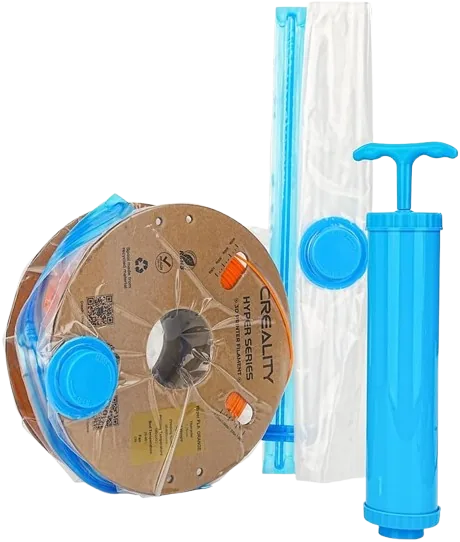
With up to seven materials loaded, spare spools pile up. Vacuum-seal whatever the H2C is not currently printing.
Amazon →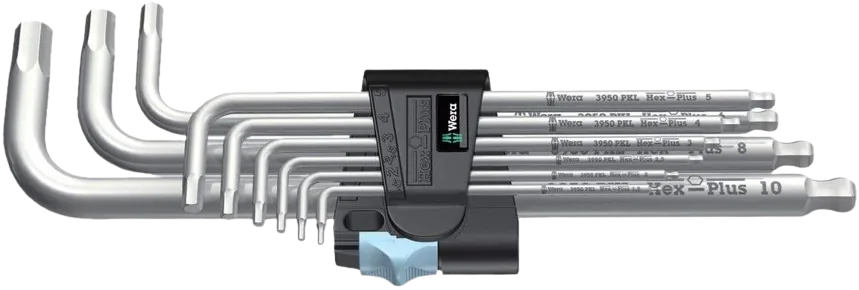
Quality ball-end hex keys for assembly and maintenance work on a machine this complex.
Amazon →Affiliate links. We may earn a commission at no extra cost to you.