H2S
Engineering-gradeA different tier entirely. 1,000 mm/s, 350°C hotend, 65°C actively heated chamber, and a build volume that finally gives you real room. The H2S is the single-nozzle way into Bambu's engineering tier.
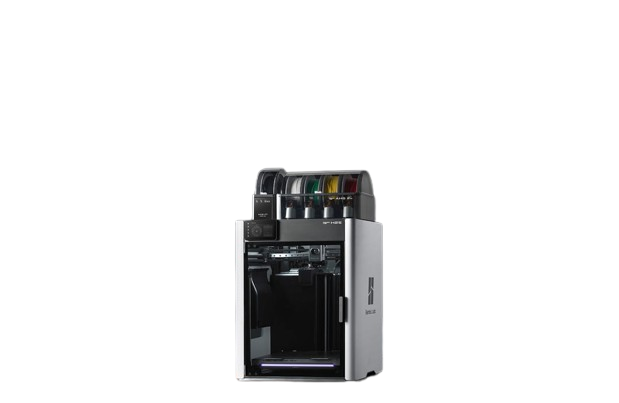
Image: Bambu Lab.
Should I buy the H2S?
Yes, if you print high-temp engineering materials: with the 350°C hotend and active 65°C chamber, Bambu's filament list adds PPS and fiber-filled PPS, and the heated chamber cuts warping on PC and other warp-prone grades (a capability shared with the H2D and H2C). For PLA/PETG/ABS/ASA, the P2S at $549 is a better fit.
Who should buy the H2S?
- Engineering materialsGood fit
A 350°C hotend and an actively heated 65°C chamber for warp-prone engineering filament, in a 340 × 320 × 340 mm build volume. X2D vs H2S → - PLA, PETG, ABS and ASALook elsewhere
The enclosed P2S prints all four; the H2S earns its price with 350°C materials and size. P2S vs H2S → - Two materials or soluble supportsLook elsewhere
The H2S has one nozzle; the H2D carries two on the same toolhead. H2S vs H2D → - Laser engravingDepends
Takes Bambu's 10W laser and the cutting module; the 40W laser kit is only offered for the H2D and H2C. H2S vs H2D → (Bambu store)
Known issues
- PTFE tube detachment detection is temporarily disabled; Bambu lists it as a known issue of the current firmware 01.02.00.00. (Bambu release notes)
Known issues only from Bambu's own wiki, firmware release notes, FAQ, blog and recall pages, checked October 2, 2026. Specs: our table below and Bambu's spec pages.
| Motion & Print | |
|---|---|
| Build volume | 340 × 320 × 340 mm (13.4 × 12.6 × 13.4 in) |
| Max speed | 1,000 mm/s |
| Acceleration | 20,000 mm/s² |
| Motion system | CoreXY (H-series) |
| Layer height (0.4 mm nozzle) | 0.08–0.28 mm (Bambu Studio default range) |
| Extruder | Direct drive (high-temp) |
| Nozzle (stock) | 0.4mm hardened steel |
| Temperature & Enclosure | |
|---|---|
| Nozzle max | 350°C |
| Bed max | 120°C |
| Enclosure | Yes |
| Chamber heating | Active (65°C) |
| Air filter | 3-stage: G3 pre-filter + H12 HEPA + carbon |
| Carbon filter | Yes |
| Bed surface | PEI (magnetic, high-temp) |
| Auto leveling | Yes |
| Vibration comp. | Yes (accelerometer) |
| Flow calibration | Yes (automatic) |
| Camera | Yes (included) |
| AMS | AMS, AMS 2 Pro, AMS HT (up to 24 colors: 4× AMS 2 Pro + 8× AMS HT) |
| Dual nozzle | No (single, see H2D) |
| Laser + cut module | Optional (10W, sold separately) |
| Connectivity | Dual-band Wi-Fi (2.4 + 5 GHz), LAN mode |
| Machine dimensions | 492 × 514 × 626 mm |
| Weight | 30 kg (Laser Edition 30.5 kg) |
| Power supply | 100–120V or 200–240V AC (regional versions), max 2050W at 220V / 1170W at 110V |
| Status | Current (Aug 2025) |
The H2S is a fundamentally different machine from everything else in Bambu's lineup. The combination of 350°C hotend, 65°C actively heated chamber, and 1,000 mm/s print speed adds materials Bambu does not list for its current 300°C printers, such as PPS and fiber-filled PPS, and gives PA-CF, PC blends and other engineering polymers sustained chamber heat instead of a passive enclosure.
It launched in August 2025 at $1,249, just $50 above the X1 Carbon (the X1C is discontinued since March 2026, superseded by the X2D), and now sells for $1,199 in the Bambu US store. For that money: faster print speeds, higher-temperature hotend, active heated chamber, and a larger build volume. The X1C's Lidar quality sensing was the only reason to pick it instead, and with the X1C out of the lineup that choice no longer applies to new purchases. The H2S is heavy (30 kg) and draws up to 2,050W at 220V (1,170W on 110V models). For PLA and PETG it's overkill, but for engineering parts it's the right tool.
Pros
- 350°C hotend: PPS and fiber-filled PPS on top of PC and PA-CF
- 65°C active heated chamber: reliable engineering prints
- 1,000 mm/s: Bambu's top speed (shared with the X2D and the other H2 models)
- 340 × 320 × 340 mm: large, useful build volume
- Hardened steel nozzle stock
- Up to 24 colors (4× AMS 2 Pro + 8× AMS HT)
- 3-stage filtration: G3 pre-filter, H12 HEPA, activated carbon
Cons
- Heavy at 30 kg, not portable
- Up to 2,050W draw at 220V (1,170W at 110V), check your circuit
- No Lidar (X1C has this)
- No dual nozzle (H2D has this)
- Overkill for PLA/PETG printing
- AMS 2 Pro / AMS HT sold separately
| Material | Support | Notes |
|---|---|---|
| PLA / PLA+ | Works | Open the door partially for cooling. Overkill but functional. |
| PETG | Works | Fine, but the H2S is not the machine for PETG day-to-day. |
| ABS / ASA | Excellent | The active chamber makes these even more reliable than on P2S. |
| PA-CF (PA12-CF, PA6-CF) | Excellent | This is what the H2S is designed for. Reliable with 65°C chamber. |
| PC (Polycarbonate) | Supported | 350°C hotend + active chamber suit PC well. Dry filament required. |
| PC-CF / PC-ABS | Supported | Hardened nozzle stock helps. Good results. |
| PA6-GF / PA12-GF | Excellent | Glass-filled nylons work well here. |
| TPU | Supported | Works. Use low chamber temp for flexible materials. |
| PEEK / PEI / ULTEM | Not listed | Not on Bambu's H2S filament list. Check the filament maker's specs before trying. |
Pre-heat protocol: For engineering materials, set chamber target to 65°C and wait until it is reached before starting the print. Let the temperature stabilize for 5 minutes. Parts printed with a pre-heated chamber have consistently better adhesion.
Dry filament: PA-CF and PC are hygroscopic. Always dry filament before printing (75–85°C for 8–12 hours, per Bambu). Moisture causes popping, stringing, and poor layer adhesion, even the best chamber won't fix wet filament.
Power: The H2S draws up to 2,050W at 220V (1,170W at 110V) while the bed heats up. Verify your circuit can handle this, especially if other equipment is on the same breaker.
Network: The H2S connects over dual-band Wi-Fi (2.4 and 5 GHz). In the H2 series, Bambu lists a wired Ethernet port only for the H2D Pro, so plan for good Wi-Fi coverage in the workshop.
H2S or X1C? H2S. The X1C is discontinued since March 2026 (superseded by the X2D), so it is no longer a new-purchase option. The H2S is faster, larger, higher temp, and has an active chamber; a used X1C only makes sense if Lidar quality sensing is specifically what you need.
H2S or H2D? H2S if single-material engineering parts or multi-color via AMS is sufficient. H2D if you need dual-nozzle printing (soluble supports, dual-material parts) or the higher-power 40W laser. The H2S also takes the optional 10W laser and cutting module.
H2S or P2S? P2S ($549) covers ABS/ASA and, on Bambu's filament list, PC and carbon-filled nylons too. H2S ($1,199) if you need a 350°C hotend and an active 65°C chamber (among current models, only the H-series lists PPS), or the larger build volume.
Is 1,000 mm/s usable? It is Bambu's rated maximum toolhead speed. Acceleration is 20,000 mm/s², the same as the P1S and P2S, so how much faster a real print finishes depends on the model, material and quality settings.
Links to the Bambu Lab store and Amazon are affiliate links. We may earn a commission at no extra cost to you.
Starter accessories for the H2S
What we would add to a new H2S in the first month.

The H2S targets engineering materials, and PA or PC blends absorb moisture within hours. Dry every spool before it goes in.
Amazon →Carbon-fiber PC (use the PC profile) that makes use of the H2S's 350°C hotend and hardened drive train. Stiff, light functional parts.
Amazon →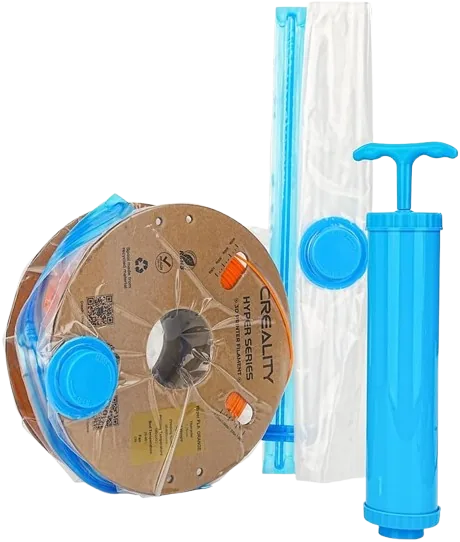
Opened engineering spools degrade fast in room air. Vacuum-seal them between H2S jobs.
Amazon →
Capricorn XS, 1.9 mm ID. Bambu specifies 2.5 mm ID tubes for the H2S (2.0 mm inside the AMS units) and advises against a smaller ID because it adds friction. In our own printers it has still worked better than the stock tube, which is why we keep recommending it; if feeding gets worse, go back to the stock size.
Amazon →Affiliate links. We may earn a commission at no extra cost to you.