Which Support Filament for Your Bambu? PLA, PETG, PVA, BVOH
Bambu sells four support filaments and has discontinued a fifth. This guide covers the material: which one fits your model, how much extra filament it takes once purging is counted, how to keep it dry, and how to dissolve and dispose of it. The slicer settings are in our guide to supports in Bambu Studio.
Short version
For PLA, try what you may already own: Bambu documents PETG Basic as a support interface under PLA Basic, and PLA Basic under PETG. The dedicated option for PLA is Bambu's Support for PLA, printed on the interface only.
PETG models need Support for PLA/PETG or a PLA Basic interface, ABS gets Support for ABS, and nylon now gets Bambu ABS or ASA. PVA earns its place under cavities you cannot reach, but only bone dry.
On a printer with one nozzle, keep any support filament to the interface. The support itself is the small part; the purge at every material change is the large one.
- size of every Bambu support filament spool
- 0.5 kg
- water PVA takes up at saturation, per Bambu's data sheet (Support for PLA: 0.43%)
- 6.25%
- warmest water Bambu allows for dissolving PVA off PLA parts
- 50°C
- Schematic, not to scale; the gap is drawn larger than it is.
- Source: Bambu Lab wiki, Support and Support Filament Usage Guide, checked November 11, 2026
Which support filament goes with which model material
A support filament is made to touch your model without bonding to it, which lets Bambu Studio drop the gap between support and model to zero for a clean underside. That only works with the right pair. Fig. 2 puts every option Bambu documents, plus BVOH from two other makers, against the model materials it is meant for.
- Support for PLA: not under PLA Aero. Bambu's warning names ABS, ASA, PC and PAHT-CF as examples of high-temperature filament. On dual-nozzle printers Bambu recommends ASA for the whole support under PA6-CF and PAHT-CF; ASA also covers PPA-CF and PPS-CF.
- BVOH: what Verbatim and Fiberlogy list; Bambu sells no BVOH. Support for PA/PET is discontinued.
- Sources: Bambu Lab wiki and US store, Verbatim, Fiberlogy, Polymaker, Prusa; full list below, checked November 11, 2026
Break-away filaments go on the interface
Support for PLA, Support for PLA/PETG and Support for ABS are brittle and peel away. For those, Bambu recommends printing only the interfaceThe dense top layers of a support, the ones that touch the model. The rest of the support, the base, is printed sparse. in support filament and the base in your model material, to save time and filament. Bambu Studio's option Avoid interface filament for base is on by default and does exactly that.
PVA: the whole support, mostly
Bambu's support filament guide wants the whole support in PVA, base and interface, with normal instead of tree supports. Its PVA store page says PVA can, depending on the case, go on the interface only, and the PVA printing guide offers project files for both. We would follow the support guide: only a whole PVA support dissolves completely, while a PVA interface on a PLA base still leaves a base to break off.
Two pairs where the sources disagree
PVA under PETG. Two of Bambu's guides call it not compatible; only the H2C guide allows it, on the right hotend fed from an AMS and never with PETG on the other hotend. For PETG, Prusa and Fiberlogy point to BVOH instead.
Support for ABS under ABS. Breaking it off is undisputed; dissolving it in limonene is not, as covered further down.
Caution
Matching pairs only
Bambu warns that a mismatched pair can clog the extruder or the nozzle, for example Support for PLA under ABS, ASA, PC or PAHT-CF, or Support for PA/PET under PLA or PETG. Check the pair in Fig. 2 before you load the spool.
Bambu's support spools and the alternatives compared
Bambu's US store lists five support filaments, all on 0.5 kg spools; Support for PA/PET is marked as discontinued. Table 1 puts them next to water-soluble filaments from other makers and the two ordinary Bambu filaments that work as an interface.
Scroll sideways for all columns.
| Filament | For models in | Removal | Moisture | Source |
|---|---|---|---|---|
| Support for PLA (Bambu) | PLA, PLA-CF; not PLA Aero | Break away | 0.43% water uptake; drying recommended | Bambu wiki, data sheet, store |
| Support for PLA/PETG (Bambu) | PLA, PETG and their CF/GF versions | Break away | 1.02%; drying recommended | Bambu wiki, data sheet, store |
| Support for ABS (Bambu, HIPS) | ABS | Break away or d-limonene | 0.14%; drying not required, recommended | Bambu wiki, data sheet, store |
| Support for PA/PET (Bambu, discontinued) | PA, PA-CF/GF, PA6-CF/GF, PAHT-CF/GF, PET-CF/GF | Break away within 2 hours | 1.23%; drying required | Bambu wiki, data sheet, store |
| PVA (Bambu) | PLA, PLA-CF/GF; not PETG | Water, at most 50°C for PLA parts | 6.25%; drying required | Bambu wiki, data sheet, store |
| PolyDissolve S1 (Polymaker, PVA) | PLA, PVB, TPU, nylon; PETG depending on the part; not ABS or PC | Water, warm and moving | Very hygroscopic; dry at 80°C for 12 hours | Polymaker wiki, data sheet |
| eSun PVA | PLA, TPU, nylon | Warm water | Dry at 45°C for more than 10 hours | eSun product page, data sheet |
| Verbatim BVOH | ABS, PLA, PET | Cold water | Not stated; sensitive to light and UV | Verbatim |
| Fiberlogy BVOH | PLA, ABS, ASA, PETG | Warm water | Dry at 50°C for 4 hours | Fiberlogy |
| eSun HIPS | ABS, PETG | d-limonene | Not stated | eSun product page |
| PETG Basic as interface (Bambu) | PLA Basic | Break away | Dry both spools | Bambu wiki |
| PLA Basic as interface (Bambu) | PETG Basic, PETG HF | Break away | Dry both spools | Bambu wiki |
Water uptake: Bambu's data sheets, at saturation at 25°C and 55% relative humidity. Dissolve times are in the PVA section; no maker gives one for BVOH or for HIPS in limonene.
Support for PA/PET is gone; ABS and ASA take over
Bambu's store page marks Support for PA/PET as discontinued and recommends Bambu ABS and ASA instead (checked November 11, 2026); the pairs are in Fig. 2. Print only the interface in ABS or ASA on a single nozzle; on dual-nozzle printers Bambu wants the whole support in ASA under PA6-CF and PAHT-CF. Neither is a dedicated support filament, so enter the support values from Bambu's support page by hand. More in our engineering materials guide.
Which AMS, which printer
Support for PLA and Support for PLA/PETG run in every AMS, the AMS lite included. Support for ABS and Support for PA/PET do not work in the AMS lite and are not for the A1 series or the P1P. For PVA, see keeping it dry.
Before you buy: support without a special spool
PLA and PETG support each other
PLA and PETG bond poorly, and Bambu documents that as a support pair: a PETG interface under a PLA model, or a PLA interface under a PETG model. It covers only Bambu's PLA Basic with PETG Basic or PETG HF, and only the interface; a whole support in the other material can come loose. Bambu Studio sets the gap to zero on its own. Plates and temperatures are in our supports guide.
Fewer material changes
With a single material, keep Bambu's gap of about 0.2 mm and improve the underside with more top interface layers or interface ironing. With two materials, less support means fewer changes: painted supports help, and in Bambu's waste guide, laying a part on its side cut changes and waste by almost 80%.
Water-soluble: PVA and BVOH
Water-soluble support is the answer for internal channels, closed cavities and anything pliers cannot reach. Bambu sells PVA. BVOH comes from makers such as Verbatim and Fiberlogy, and Bambu Studio ships Generic BVOH profiles for eleven Bambu printers, from the A1 mini to the H3C.
PVA or BVOH
Prusa, which sells BVOH, calls it the better but more expensive option: stiffer and easier to print, while PVA is more prone to clogging. Bambu publishes no comparison of its own. Third-party PVA, such as Polymaker's PolyDissolve S1 or eSun's PVA, is an option too; Polymaker advises against printing its PVA on a single nozzle because of the clog risk during material changes.
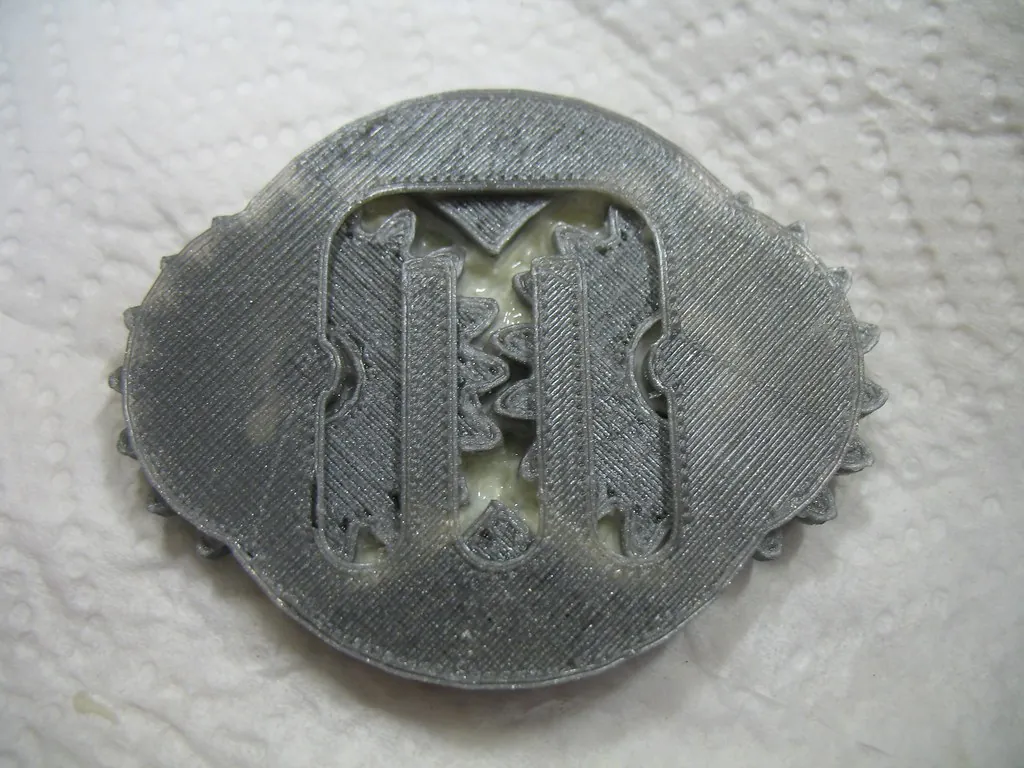
Dissolving PVA, step by step
- Start soon after the printBambu says to remove PVA supports within two hours; left longer, they soften and stick.
- Warm water, kept movingFor PLA parts, Bambu caps the water at 50°C (122°F) and Prusa at 45°C (113°F); stirring speeds things up.
- Change the waterPolymaker recommends fresh water every few hours.
- Plan for hoursBambu gives several to more than ten hours, Polymaker 6 to 12.
- Let the part dryPrinted parts are porous, so water can get inside.
Where the water goes
Bambu's safety data sheet does not class PVA as hazardous waste and refers to local rules. Polymaker says to ask your wastewater utility before pouring PVA water down the drain; UltiMaker allows it where the sewer feeds a treatment plant; Verbatim allows its BVOH in household wastewater with more than 20 times its weight in water, at most 2 kg a day. We have not checked US state or city rules.
Keeping PVA dry on a Bambu printer
Most PVA problems in Bambu's guides trace back to moisture: PVA takes up 6.25% water at saturation, against 0.43% for Support for PLA. In a room at about 55% relative humidity, freshly dried PVA takes up enough water within one to three hours to hurt print quality, so put it into a dry box or the AMS straight from the dryer. Damp PVA bends without breaking, pops in the nozzle and strings heavily; dry PVA feels stiffer than PLA Basic.
Drying values
Bambu's documents give different numbers; we would go by its drying guide, which has the most detail:
- Oven: 75 to 85°C for 8 to 12 hours.
- AMS HT: 85°C for 18 hours.
- AMS 2 Pro: 65°C for 12 hours, a setting the guide marks as one that may not fully dry the filament; the AMS 2 Pro store page says it cannot dry PVA completely.
- Heated bed of an enclosed printer: 90 to 100°C for 12 hours.
Bambu's PVA spool withstands 90°C; cardboard spools can deform. Store it below 20% relative humidity, with calcium chloride as Bambu's PVA guide recommends. More in our filament storage and drying guide and in filament dryers for Bambu printers.
The AMS lite and enclosed printers
Bambu's support filament guide does not recommend PVA with the AMS lite, because the open spool keeps taking up moisture while it prints; if you do it anyway, keep prints to about an hour. The A1 tech specs sound more positive, but the reason for caution is physical. On enclosed printers with a bed above 45°C, Bambu advises opening the door or lid so the PVA does not soften in the extruder. The H3C can keep drying it during the print, at 70°C, or 55°C next to PLA and 65°C next to PETG.
Support for ABS and d-limonene
Support for ABS is based on high-impact polystyrene (HIPS) and absorbs hardly any water. It breaks away, or dissolves in d-limonene, a compound found mainly in citrus peel. Print it in an enclosed printer, because it gives off styrene, and not on the Cool Plate SuperTack.
Neither Bambu nor eSun nor Prusa says how long it takes to dissolve. Prusa warns that some ABS and ASA filaments are affected by limonene too (its own orange ASA fell apart into flakes) and advises a brief soak, then removal by hand. If you plan to dissolve, test a scrap of the same ABS first.
Handling d-limonene
Bambu's safety notes: wear fluororubber (FKM) gloves, not latex, and a mask, ventilate, and keep it away from flames and hot surfaces such as a heated bed; its flash point is only about 48°C (118°F).
Bambu calls limonene generally considered safe. The harmonized EU classification is stricter: flammable, a skin irritant and sensitizer, and very toxic to aquatic life. Spent limonene does not go down the drain; take it to your local household hazardous waste collection.
Purge and time: one nozzle or two
On a printer with one nozzle and an AMS, every switch between model and support material means unloading, purging and wiping. In Bambu's waste guide, a cube with 153 filament changes left 83 g of waste, about 0.54 g per change; Bambu gives no time per change. Fig. 3 applies that to an assumed part: a PLA overhang 40 mm up at 0.2 mm layers, so 200 layers with support and 28 g of support, 3 g of it interface.
- Our calculation, not a measurement. The geometry is assumed; replace it with a Bambu Studio slice of your own part.
- Purge per change from Bambu's cube example in Reduce Waste during Filament Change.
The pattern holds even if the assumptions are off by a fair margin: interface only adds a gram or two of purge, while a whole support in support filament means 200 to 400 changes and a purge four to eight times the weight of the support. Flush into objects' support, on by default with a prime tower, lowers that; the prime tower itself is not counted.
Two nozzles, Vortek and tool changing
Printers that keep the support material in its own nozzle skip most of that purge.
- H2D, H2D Pro and X2D: separate nozzles; a change takes about five seconds plus re-pressurizing on the prime tower, by Bambu's figure for the H2D.
- H2C: Vortek, up to six swappable hotends, so each filament keeps its own; in a six-color example (color, not support) Bambu lists 532 g of purge and tower waste against 3,032 g on the H2D.
- H3C: one tool per material, about six seconds and 38 mg of purge per change in Bambu's internal tests under optimal conditions.
Even with two nozzles, interface only saves time: in Bambu's H2D example with PLA under PETG, a PLA interface on a PETG base finished 1 hour 20 minutes sooner than a whole PLA support (5 hours 3 minutes). For PVA across both nozzles of an H2 printer, Bambu's guides disagree, so check the one for your model. Printer-by-printer details are in our supports guide, our H2C explainer and our H3C article.
Common mistakes
| Mistake | What to do |
|---|---|
| PVA as tree support | Normal supports, with PVA for base and interface; tall, thin PVA branches tend to collapse. |
| Support for PLA/PETG on the first layer of a Cool Plate SuperTack | It damages the plate, and Bambu Studio refuses to print it. Interface only, or a raft of at least two layers. |
| Third-party PVA on the Generic PVA profile | Lower the maximum volumetric speed: Generic PVA allows 16 mm³/s, Bambu's PVA profile 6, Polymaker's wiki at most 8. |
| PVA left in the hotend after the print | Unload right away and do two or three cold pulls with PLA or PETG, not with CF or GF filament (Bambu's H3C guide). |
| PVA with a 0.2 mm nozzle | Not compatible, according to the store page, the H2C and H3C guides and the material table. |
| Support for PA/PET supports left overnight | Remove them within two hours. If they stuck, dry the part, let it cool, then remove them. |
| Support for ABS with variable layer height | Do not combine them; the print can fail. |
Problems that come down to settings, such as weak layers at the support height or strings on supported surfaces, are covered in the fixes section of our supports guide.
Common questions
Which support filament should I buy for PLA on a Bambu printer?
If you have an AMS and Bambu PETG Basic or PETG HF, try a PETG interface under PLA Basic first; Bambu documents the two as a support pair. The dedicated option is Support for PLA on the interface only. Buy PVA for cavities you cannot reach, and only if you can keep it dry.
Can I use PVA as support for PETG on a Bambu printer?
Bambu's support filament guide and its PVA guide say no; only its H2C guide allows it, on the right hotend fed from an AMS. For PETG models Bambu recommends Support for PLA/PETG or a PLA Basic interface, and Prusa recommends BVOH.
Can I use PVA in the AMS lite?
Bambu's support filament guide does not recommend it, because the AMS lite is open and PVA keeps absorbing moisture while it prints. If you try anyway, keep prints to about an hour.
Is Bambu Support for PA/PET discontinued?
Yes. Bambu's US store marks it as discontinued (checked November 2026) and recommends Bambu ABS under PA6-GF and Bambu ASA under PA6-CF, PET-CF, PAHT-CF, PPA-CF and PPS-CF, with the support parameters set by hand.
Can I pour PVA water down the drain?
Bambu does not say, and the rules are local. Polymaker advises asking your wastewater utility first; UltiMaker says PVA may go down the drain where the sewer feeds a treatment plant. Spent d-limonene does not belong in the drain.
Sources
Bambu Lab wiki, store pages and data sheets, Bambu Studio source code, filament makers' pages. Last checked November 11, 2026.
ShowHide
Bambu Lab wiki, with the date each page was last edited: Support Filament Usage Guide (August 25, 2026: pairs, removal, AMS and printer limits, drying, PVA on the A series and H2 series, Support for ABS and limonene safety, troubleshooting); PVA Printing Guide (July 27, 2026: whole support, project files, humidity, calcium chloride, AMS HT, dissolving); PVA Printing Guide for the H3C (November 10, 2026: drying during the print, desiccant, cold pull, warning signs); Support for ABS Printing Guide (July 27, 2026: flush 800, interface layers, safety); PLA Basic and PETG HF/PETG Basic for support (September 28, 2026: the mutual pair, the H2D timing example); Support in Bambu Studio (June 2, 2026: removal methods, mismatched pairs, ABS and ASA under engineering filament, the two-hour rule, the 0.2 mm gap); Support for PLA/PETG with Cool Plate SuperTack; Filament guide: Material Table (November 6, 2026); Filament Drying Recommendations (July 31, 2026); Reduce Waste during Filament Change (February 11, 2026: the cube example, orientation, layer height, purge for support filament); Filament Grouping Strategy for Dual Nozzle Printers; H2C Filament Printing Guide; Vortek Workflow and Function; H3C FAQ; H3C Filament Compatibility Guide; AMS lite FAQ; A1 FAQ.
Bambu Lab US store, read November 11, 2026: PVA, Support for PLA (New Version), Support for PLA/PETG, Support for ABS, Support for PA/PET (discontinued), support filament category, AMS 2 Pro. Bambu data sheets: PVA TDS, PVA SDS, Support for PLA TDS, Support for PLA/PETG TDS, Support for ABS TDS, Support for PA/PET TDS. Bambu product pages: H2D, H2C (six-color example), X2D (auxiliary nozzle, example models, footnote 2), H3C (6 s and 38 mg, footnotes), A1 tech specs.
Bambu Studio source on GitHub, master branch, read November 11, 2026: PrintConfig.cpp (Avoid interface filament for base and Flush into objects' support, both on by default), SupportRecommendedParams.cpp (zero gap for the PLA and PETG pairs), filament profiles (Bambu PVA, Generic PVA, Generic BVOH and Generic HIPS: volumetric speeds, densities, printers).
Other makers: Polymaker, PolyDissolve S1 wiki, data sheet V5.5, product information sheet V1.1 and shop; eSun, PVA and HIPS; Verbatim, BVOH 55903; Fiberlogy, BVOH; Prusa knowledge base, Water soluble (BVOH/PVA), Water-soluble materials (PVA/BVOH) and HIPS, and the Prusa store, support material (BVOH it sells); UltiMaker, PVA Removal Station user manual v1.4. All read November 11, 2026.
d-limonene: PubChem, GHS classification (including the harmonized EU classification) and flash point.
We have not run our own print tests for this guide. The compatibility, drying and dissolving figures are the makers'; the purge example is our own arithmetic on assumed geometry. Photo: Flickr, under the Creative Commons licence named in the caption; it shows someone else's print, not ours.
- Title
- Which Support Filament for Your Bambu? PLA, PETG, PVA, BVOH
- Section
- Guides
- Published
- Last updated
- Last checked
- November 11, 2026
- Sources
- Listed under the article
- Page
- Status
- Not affiliated with Bambu Lab