The X1 Series Is Discontinued: What It Means
Published · Last updated · See the X2D successor →
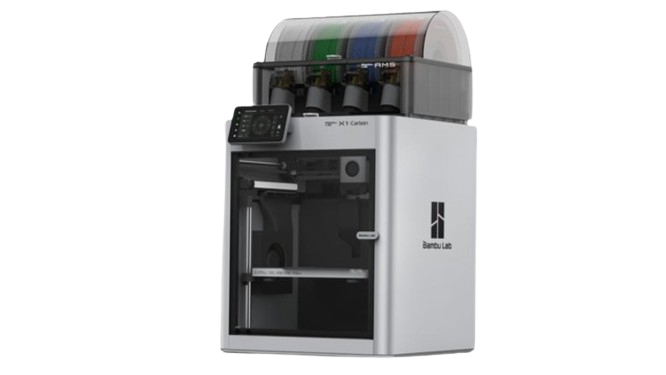
Image: Bambu Lab.
Short version
Bambu Lab discontinued the entire X1 series (X1C, X1E, and the base X1) on March 31, 2026. The X2D ($649), launched two weeks later, fills the X1 Carbon's place in the lineup, and Bambu's X2D page benchmarks it directly against the X1C. If you own an X1, nothing breaks: Bambu's EOL schedule keeps feature updates and bug fixes coming until May 31, 2027, security patches until May 31, 2029, and spare parts and support until March 31, 2031. If you were about to buy an X1C, buy the X2D instead. For higher-temperature engineering work, look at the H2S or H2D.
What was discontinued
On March 31, 2026, Bambu Lab reached end of life (EOL) for the complete X1 line. That covers all three models: the X1 Carbon (X1C), the enterprise X1E, and the base X1. These machines are no longer in active production. What remains in the channel is existing stock, so you may still see units listed until retailers sell through.
The X1 Carbon launched in May 2022 at $1,199 and was Bambu Lab's flagship for nearly three years. The X1E followed in October 2023 at $2,499 as the enterprise variant, adding an actively heated 60°C chamber, Ethernet, and stricter security controls. Both are now retired in the same wave.
Why now: the X2D replaces the X1C
The successor followed two weeks after the March 31 end of life (Bambu's EOL announcement does not name one): Bambu Lab launched the X2D on April 14, 2026 at $649, and it takes over the X1 Carbon's slot in the lineup at $550 less. On paper the X2D beats the X1C on most hardware points:
- Active chamber: the X2D actively heats its enclosure to 65°C. The X1C only has a passive enclosure that warms as a side effect of printing.
- Dual nozzle: the X2D pairs a direct-drive primary nozzle (up to 300°C, higher speed) with a Bowden support nozzle. The X1C is single nozzle.
- More AMS colors: the X2D takes up to 25 colors (4 AMS 2 Pro + 8 AMS HT units, plus an external spool on the second nozzle); the X1C tops out at 4 AMS units and 16 colors, and since firmware 01.09.00.00 those can be AMS 2 Pro or AMS HT units too.
- Price: $649 base ($899 Combo with AMS 2 Pro) versus the X1C's $1,199.
There is one deliberate trade-off. The X2D has no Lidar. The X1 series carried a Lidar sensor for real-time first-layer scanning and flow calibration; the X2D runs Flow Dynamics Calibration on its main nozzle and uses its cameras for AI failure detection instead, and its second nozzle is an auxiliary hotend with a shorter filament list. For most hobby and prosumer printing the gap is not noticeable, but if your workflow leans on Lidar this is the detail that matters. We break the swap down in X2D vs X1C.
What it means if you already own an X1
End of life does not mean end of support. Bambu Lab's EOL announcement sets fixed dates for existing X1-series owners:
- Spare parts and support until March 31, 2031. Bambu says related spare parts stay available through its online store and authorized service centers for that five-year period, though some parts may sell out earlier.
- Feature updates and bug fixes until May 31, 2027. Software and firmware keep getting both on that timeline.
- Security patches until May 31, 2029. After feature work stops, security fixes continue for two more years.
Update, August 6, 2026: the promise held
On August 4, Bambu shipped firmware 01.12.00.00 for the X1 and X1C and 01.03.00.00 for the X1E, the first builds in 237 days. Both carry security fixes, improved purge chute pile-up detection and farm-mode plate clearing on the device screen; the X1E build also fixes an occasional network certificate install failure. So the schedule above is being kept, including the feature updates Bambu promised until May 2027. Current versions for every model: firmware tracker.
In practice: keep printing. Your X1C or X1E is not obsolete, and there is no rush to replace a machine that still does what you need. If a part fails, it can be sourced. Feature updates and bug fixes end on May 31, 2027, security patches continue until May 31, 2029, and after that the printer keeps working on its last release. See our firmware updates page for how to update safely in the meantime.
What it means if you were about to buy
If you were shopping for an X1 Carbon, buy the X2D instead. You get a better machine (active chamber, dual nozzle, more AMS slots) for $550 less, and you are buying into a current, actively supported platform rather than one that just went EOL. The only reason to still seek out an X1C is if you specifically need Lidar flow calibration and can find remaining stock.
If you were looking at the X1E for engineering materials, the picture is different. The X2D tops out at a 300°C nozzle. Bambu lists ABS, ASA, PC, PA and CF/GF-reinforced PA6, PAHT and PPA for it, but neither PPS nor PPS-CF/GF; Bambu's filament guide rates PPS-CF/GF at 310–340°C and clears it only for the H2 series and the X1E. For PPS work, step up to the H2S ($1,199) or the H2D ($1,549). The H2D adds a full dual-nozzle switching toolhead, so it is the closest thing to an "X1E successor" in capability terms even though it sits in a different series.
| Feature | X1C (EOL) | X2D | X1E (EOL) | H2D |
|---|---|---|---|---|
| Status | Discontinued | Active | Discontinued | Active |
| Price (MSRP; H2D: US store) | $1,199 | $649 | $2,499 (2023 launch; Bambu US now lists $2,899 incl. AMS) | $1,549 |
| Chamber heating | Passive | Active (65°C) | Active (60°C) | Active (65°C) |
| Nozzles | 1 | 2 (DD + Bowden) | 1 | 2 (switching) |
| Max nozzle temp | 300°C | 300°C | 320°C | 350°C |
| Lidar | Yes | No | Yes | No |
The bottom line
The X1 series had a long run and defined Bambu Lab's reputation for enclosed, reliable printing. Retiring it is a lineup cleanup, not a signal that the machines stopped being good. Owners are covered on parts and firmware for years. Buyers should move to the X2D for general printing or to the H-series for high-temperature engineering work.