Bambu Lab R1: The Specs, the Price and the Wait
Published · Launch coverage, building on our teaser reporting from August · Product news · Bambu's first machine that is not a 3D printer
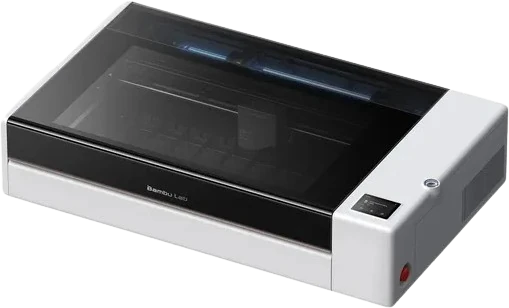
The R1 as Bambu shows it: one sealed enclosure over the full bed, touchscreen on the right, emergency stop on the front corner. The touchscreen is unusual in this class, and the machine is smaller than most 55 W CO2 lasers with the same working area. Image: Bambu Lab.
Short version
The R1 launched on September 22, 2026 at $2,499 in the US and €2,499 in the EU: a 55 W CO2 laser with a 600 × 300 mm bed, 1,000 mm/s top speed and Class 1 safety in its standard enclosed form. It is Bambu's first standalone machine that is not a 3D printer. What you cannot do is buy one today. Bambu's launch blog says shipping starts in October; the EU store puts a date on it and quotes "ETD: Versand ca. 06. November 2026". Almost every accessory is out of stock. The exhaust hose and fan are in the box; if you cannot vent out of a window, the E1 Pro purifier adds $899.
The spec sheet
Bambu publishes a two-page R1 Spec sheet as a PDF, linked from the store listing rather than from the product page. It is more useful than the marketing copy above it, and in two places it contradicts it. The numbers below come from that document.
| Parameter | Specification |
|---|---|
| Laser | 55 W CO2 |
| Work area | 600 × 300 mm standalone, 600 × 3000 mm with the conveyor |
| Max cutting capacity | Short-focus lens (in the box): 15 mm black walnut, 20 mm acrylic. Medium and long focus: 18 mm black walnut, 20 mm acrylic |
| Spot size | Ø0.11 mm short focus, Ø0.17 mm medium, Ø0.19 mm long |
| Speed | 1,000 mm/s at 20,000 mm/s² |
| Positioning | Dual camera, dual laser, dual encoder; accuracy under 0.2 mm |
| Absolute motion accuracy | Under 0.1 mm over 600 mm, with the Vision Encoder ($99.99, sold separately) |
| Cut and engrave | Wood, acrylic including clear, leather, fabric, paper, EVA foam, shell |
| Engrave only | Coated metal, glass, ceramic. Bare metal cannot be engraved |
| Max workpiece height | 21 mm on the slats alone, 57 mm with the base tray, up to 248 mm with the riser base |
| Noise | About 68 dB at full load, measured at 1 m. Air pump, fans and the cooling loop |
| Air assist | Built-in pump, 30 l/min at 30 kPa |
| Weight and power | 33.5 kg, 780 W maximum draw, 100–240 VAC |
| Space required | 940 × 660 × 650 mm with the lid open, 1,140 × 860 × 750 mm with 100 mm clearance around it |
| Software | Bambu Suite, Windows and macOS. No Linux build is listed |
| Safety | Class 1 enclosed, lid-open stop, flame detection, safety key and emergency stop as standard |
One number in there has drawn attention in Bambu's own launch-day forum thread: the air assist runs at 30 kPa. A user comparing it against the competition puts the xTool P2S at 200 kPa and the P2 at 150, and reports checking the Chinese spec listing to rule out a typo. Air assist pressure affects how cleanly smoke and molten material clear the kerf, so if that comparison holds it is a real difference rather than a spec-sheet curiosity. It is a forum observation, not a Bambu statement, and we have not verified the competitor figures ourselves.
Three places where Bambu contradicts Bambu
The 20 mm claim. The product page advertises cutting "materials up to 20 mm thick in a single pass" and footnotes it with "requires the medium- or long-focus lens, sold separately." The spec sheet lists 20 mm acrylic for the short-focus lens too, the one that ships in the box. What actually depends on buying a lens is the wood figure: 15 mm with the stock lens, 18 mm with the medium or long one. Worth knowing before you assume the footnote costs you money. The lenses are $30.99 and $31.99.
Revolve shape processing. Footnote 4 on the product page says "at launch, only Cylinder Processing is supported. Revolve Shape Processing will be added in a future firmware update." The spec sheet lists revolve shape processing as supported, full stop. The rotary attachment guide in Bambu's own wiki sides with the footnote and names the firmware: 01.01.00.00 does cylinders only. The spec sheet appears to describe what the hardware can do rather than what shipped. If you are buying the rotary for anything that is not a straight cylinder, that distinction is the whole purchase.
Ceramic. The product page lists ceramic under engrave-only materials. The granular materials matrix in Bambu's wiki lists both glossy and matte ceramic as not supported, for engraving and cutting alike. One of the two is wrong and Bambu has not said which.
What it costs once it is actually working
The headline number is the same on both sides of the Atlantic and does not mean the same thing. Bambu's own blog: "R1 is priced at $2,499 in the US (before tax, shipping included) and €2,499 in the European Union (tax included, shipping excluded)." The US price excludes sales tax and includes freight on a 33.5 kg machine; the EU price is the other way round. Accessory prices below are listed for both stores, because they do not track each other either: the conveyor is $499 against €519, while the fire extinguishing kit is $199 against €179.
The $2,499 buys a complete machine in one specific case: you can run the supplied hose and fan to an open window. Everything below is what Bambu's EU store charges to cover the cases where you cannot, or where you want the capability the marketing pages show.
| Part | US | EU | What it is for |
|---|---|---|---|
| E1 Pro Air Purifier | $899 | €899 | Needed if you cannot vent outside. The single biggest add-on |
| Conveyor (auto feeder) | $499 | €519 | Stock up to 3 m. Needs the riser base |
| Riser base | $389 | €409 | Taller workpieces. Required for both conveyor and rotary |
| Laser tube assembly | $372 | €386 | Consumable. Bambu publishes no tube life figure |
| Rotary attachment | $275.99 | €303.99 | Bottles, cups, bowls. Needs the riser base |
| Auto fire extinguishing system | $199 | €179 | Refill cylinder $49.99 / €69.99 |
| Guide rail extension | $99.99 each | €103 each | The conveyor alone does not reach 3 m. One extension gets you to 2,000 mm, two to 2,500 mm, three to 3,000 mm |
| Vision Encoder | $99.99 | €99.99 | The part the "under 0.1 mm" figure depends on. Out of stock in the EU store on launch day |
| Focus lens, medium / long | $30.99 / $31.99 | €31.99 / €32.99 | Takes wood cutting from 15 mm to 18 mm |
And the maintenance schedule is not light
Bambu publishes a periodic maintenance table in the wiki, and it is worth reading before you budget your time rather than your money. The reflective mirrors and both cameras want cleaning every 8 operating hours. The focus lens every 16. The exhaust fan and its filter every 20, or sooner if visibly dirty. Rails and belts every 50 to 100. The coolant gets fully replaced every six months, and the flame sensor is a check before every job. This is normal for a glass-tube CO2 machine and abnormal next to a Bambu printer, which is the comparison most buyers here will be making.
The bundles are worth the arithmetic. The Long Material Bundle is the machine plus riser and conveyor: $3,289 against $3,387 bought separately, or €3,329 against €3,427. Either way it saves about a hundred. Adding the rotary takes it to $3,499 against $3,663 separately, or €3,559 against €3,731. Small margins, but they go the right way, which is not always true of bundles.
Class 1 applies to the machine as it ships, sealed. Bambu says so itself, in a footnote:
When used with the riser base or the auto-feed accessory, the enclosure is no longer complete and the laser cutter changes from an enclosed Class 1 device to a Class 4 device, requiring CO2 laser-safety eyewear, and is intended for professional use by trained personnel only. Bambu Lab, R1 product page, footnote 8
The one that catches people out
The two accessories that unlock the furniture-scale work in the marketing images are the two that end the goggles-free operation the safety section promises. Buy the riser or the conveyor and you are operating a Class 4 laser. In a commercial setting that pulls in eye protection, a risk assessment and, in Germany, a laser safety officer.
From one teaser image to a spec sheet
Update, September 14, 2026: Bambu posted a second teaser, "Big job. Light work.", and renamed the product page to "Bambu Lab R1 CO2 Laser Engraver & Cutter". Its description now reads: "Meet Bambu Lab R1, our first CO2 laser engraver and cutter. From 3D printing to laser, we make it easier to create with more materials. Coming September 22." The forum announcement carries the same date in its title. Two of the three open questions from August are therefore settled: the laser source is a CO2 tube, not a diode, and the launch is dated. Bambu also offers subscribers 15% off, valid 60 days after launch and stackable with an R1 add-on sale, which reads like accessories are launching alongside the machine.
Update, September 15, 2026: a third teaser, "Cut clear acrylic as easily as wood", names the first materials: "Wood, clear acrylic, leather, glass… R1 handles them all." Clear acrylic is the giveaway material for a CO2 source (a blue diode passes straight through it), and glass on the list means engraving rather than cutting. It was a materials claim rather than a spec sheet, and it held up: the launch confirmed clear acrylic as a headline material and glass as engrave-only.
The August teaser was one image and two sentences: "ONE MORE TOOL. More power. Made simple." The official R1 page confirmed the category back then. Its page description reads: "Meet Bambu Lab R1, our first laser engraver and cutter. From 3D printing to laser, we make it easier to create with more materials. Coming September." Worth noting: the first version of that page, live on August 15, was more ambitious, saying Bambu is "building your personal manufacturing hub." The wording has since been toned down, but the direction it revealed stands.
The direction was right from the first image. The R1 is a laser engraver and cutter, it is a standalone product rather than another toolhead module, and Bambu is framing it as an ecosystem move: one platform covering printing, cutting and engraving.
What the community read into the teaser, and how it turned out
The August thread passed 90 replies and 5,000 views within four days. The speculation clustered around two questions; the first now has an answer.
Laser type. The teaser render shows a visible beam engraving fine lines into wood, which several forum members read as a diode laserA compact solid-state laser type used in most consumer engravers. Cheaper and smaller than CO2 tube lasers, but generally less powerful for cutting thick or clear materials. in a gantry layout rather than a CO2 machine. That reading was wrong: on September 14 Bambu confirmed a CO2 laserA gas-tube laser at roughly 10.6 micrometres. Cuts wood, acrylic, leather, paper and fabric far better than a diode of comparable wattage, and cuts clear acrylic, which diodes cannot. Does not mark bare metal without coating.. That puts the R1 against xTool's P-series and Glowforge rather than against budget diode engravers, and it means the machine needs an enclosure, a tube and usually exhaust, all of which point at a higher price than the diode crowd was hoping for.
Price. The thread ran on hope: the widely agreed sentiment was that a 40 W-class machine under $1,000 would be a hit, while a premium price would push buyers back toward established laser brands. That hope did not survive the CO2 confirmation, and the launch settled the rest. At $2,499 the R1 sits inside the existing desktop CO2 bracket rather than under it. Bambu did not do here what the A1 and the P1S did to their segments; it matched the going rate and competed on features instead.
Where the R1 fits in Bambu's lineup
Until now, cutting and engraving lived inside the printer line. The H2D, H2S and H2C offer optional laser modules (10W on the H2S, 10W or 40W on the others) plus a drag-knife cutting module, and the A2L has an optional cutting kit with no laser at all. A dedicated laser machine is a different move: it puts Bambu head-to-head with xTool, Glowforge and the crowded diode-engraver market instead of selling lasers only to people who already bought an H2.
It also fits a clear pattern for 2026: Bambu has been widening from "3D printer company" to "digital fabrication company," and the R1 is the first product where the printer is not the anchor. If the AMS-style ecosystem playbook applies here, expect tight Bambu Suite integration, first-party materials in the store, and aggressive bundle pricing.
What we still do not know
One thing survived the launch unanswered, and it is the one that matters. Tube life decides the running cost of any glass-tube CO2 machine, and Bambu publishes no hours figure at all. That is a deliberate choice rather than an omission: the wiki says the machine tracks tube health from accumulated process time and warns you when output drops, so replacement is situational. Useful in practice, useless for budgeting. The replacement assembly price is not listed either. Also still open: whether any third-party software will drive this machine. Bambu names third-party slicers on its printer pages and names none here.
What CO2 actually changes
The word CO2 already answers most of the questions a spec sheet would: what the machine can cut, what it cannot, what it needs in the room and roughly what that class of machine costs. We took that apart in a separate piece: CO2 vs diode, and what Bambu's move into lasers changes.
What happens next
Pre-orders on bambulab.com/R1 are quoted as shipping from around November 6, 2026, which means the first independent long-term reports will not exist until late in the year. The open questions above are the ones worth watching, tube life above all. We will update this page as Bambu fills them in, and as real ship dates replace the estimate.
Worth pre-ordering if
- You want clear acrylic, which no diode laser will ever cut, at any wattage
- You can vent to a window, which is the difference between $2,499 and $3,398
- You already run Bambu printers and want the same software and account rather than a second ecosystem
- Setup time matters to you: the automatic optical alignment replaces an hour of thermal paper and test shots with about a minute
- You can wait until November, and longer for most of the accessories
Look elsewhere if
- Your workflow runs on LightBurn. Bambu names third-party slicers on its printer pages and names no third-party laser software here
- You need the machine now. This is a pre-order, and on launch day almost every accessory for it, the Vision Encoder included, was already out of stock
- You want to engrave bare metal. That is a fiber laser, and no amount of CO2 wattage substitutes for it
- You are buying the rotary for anything other than straight cylinders. Revolve shape processing is a promised firmware update, not a shipped feature
- You need to budget consumables. Bambu publishes no tube life figure at all
The interesting part is the setup, not the price
At $2,499 the R1 sits inside the desktop CO2 bracket rather than under it, so this is not the A1 moment some people were hoping for. What Bambu actually brought is a different thing: the two jobs that make a CO2 laser annoying to own, aligning the optical path and placing the work accurately, are the two it automates. A minute with a sensor instead of an hour with thermal paper is a real argument for anyone buying their first laser rather than their third. Against that, put the three things the launch did not cover: no tube life figure to budget against, no word on third-party software, and a Vision Encoder that the accuracy claim leans on and that was out of stock on day one. None of those is a reason not to want one. All three are reasons to let the first shipments land before you decide.
Sources: Bambu Lab, R1 Spec sheet (PDF linked from the EU store listing, accessed September 22, 2026) for work area, per-lens cutting capacity, spot sizes, weight, power draw, connectivity and software support. Bambu Lab R1 product page at bambulab.com/en/r1 (accessed September 22, 2026) for the 1,000 mm/s and 20,000 mm/s² figures, the Class 1 statement and all footnotes quoted above, including the Class 4 warning and the revolve-shape note. Bambu Lab US and EU stores, R1 listing and accessory product pages (accessed September 22, 2026) for both price columns, the bundle prices, the "ETD: Versand ca. 06. November 2026" pre-order date, the box contents and every accessory price in the cost table. Earlier teaser reporting on this page is from the Bambu Lab forum announcement of August 13, 2026 and the product page as it read on August 15 and 17 and September 14 and 15; community price expectations from that period were speculation and are marked as such. Where the spec sheet and the product page disagree, both wordings are quoted rather than reconciled.