Bambu Cloud Postmortem: What Third-Party Tools Can Still Do
Short version
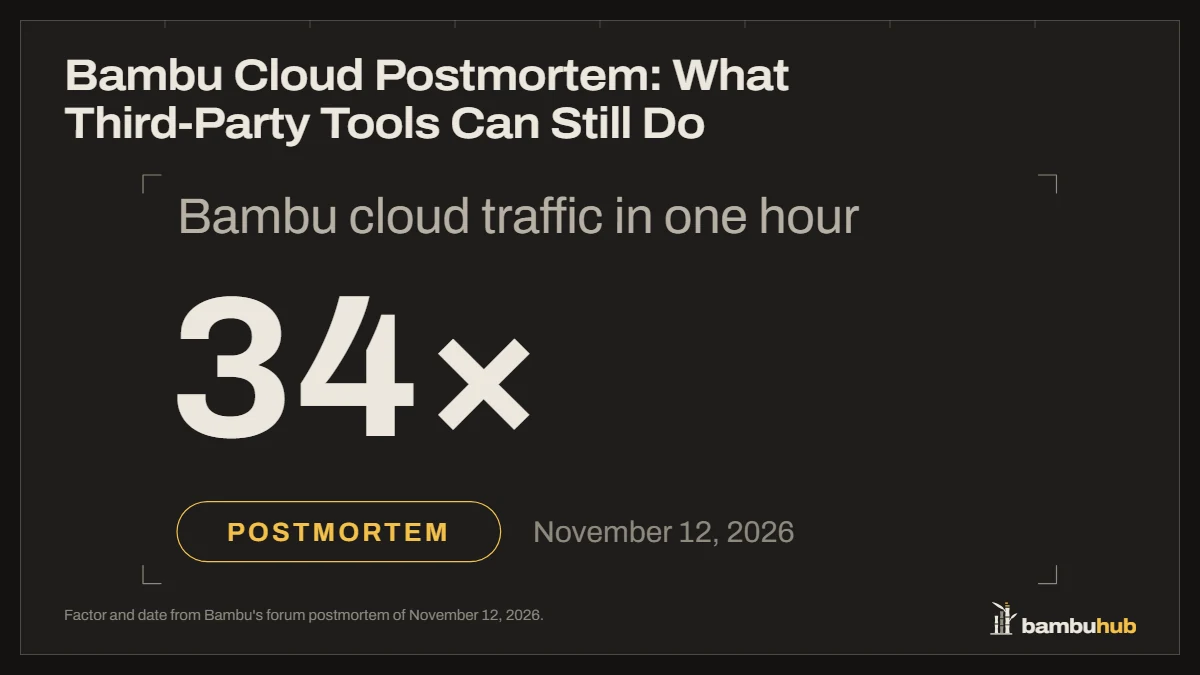
From November 9, 2026, Bambu Lab's cloud was flooded with requests to one endpoint, the list of print jobs: about 34 times the normal traffic within an hour, roughly 20 million requests a day at the peak. The source was a bug in version 2.3.0 of ha-bambulab, the community Home Assistant integration, which sent those requests under OrcaSlicer's name. Bambu blocked that identity, some users were affected, and ha-bambulab 2.4.0 fixed the bug on November 11. If you run the integration, update to 2.4.0 or newer; OrcaSlicer was not the cause. Bambu's postmortem of November 12 also restates its rules: third-party tools may keep reading printer status within reasonable limits, while starting prints, live video, binding and firmware updates go through Bambu Connect.
What happened
On November 12, 2026, Bambu Lab posted a postmortem in its forum about “abnormal traffic” earlier that week. Requests to its cloud “surged roughly 34-fold in just one hour” and peaked at roughly 20 million requests a day, still growing. Almost all of them hit one endpoint, GET /v1/user-service/my/tasks, which returns the status of print jobs. They came from many home internet connections, and they carried the client identity of OrcaSlicer and an older version of Bambu's network plug-in.
At that pace, Bambu writes, the service was “only hours away” from becoming unavailable, which would have put everyday printing at risk for its users. It blocked the anomalous traffic after an urgent review. “Some users were affected while we adjusted the policy,” the post says, without saying how many or for how long.
- Dates in UTC, from the GitHub issues and releases and Bambu's forum post; the block date is the latest it can be (Bambu's issue of November 11 says the identity was already blocked).
- Bambu gives no traffic curve, only the rise of about 34 times in one hour and the peak of about 20 million requests a day.
The order of events is public on GitHub. On November 10, Bambu opened an issue in the OrcaSlicer repository: requests from OrcaSlicer clients had risen at least 30-fold since the OrcaSlicer 2.5.0 release, and without a fix Bambu would “have no choice but to block these requests.” OrcaSlicer's maintainers traced the endpoint and found that OrcaSlicer asks for the task list in one place only, its Multi-device page, which is off by default. On November 11 one of them pointed to version 2.3.0 of ha-bambulab, and Bambu opened an issue there the same day.
The bug in ha-bambulab
ha-bambulab is the community integration that brings Bambu printers into Home Assistant; it connects through Bambu's cloud or in LAN mode. It is meant to ask the cloud for the current print job once per print. Bambu's issue shows what changed in 2.3.0, released November 8: the trigger for that request now also covered printers in the paused and finished states. A printer that stayed finished, with a job file the integration could not match, met the condition again on every status message it sent, and each time the integration requested the task list.
A maintainer confirmed it within a few hours: the change had turned “what should have been a one-time call per print” into a repeating one. The change was reverted, and the integration got its own user agentThe name a program sends with each web request to say what it is. Before 2.4.0, ha-bambulab sent the same identity as OrcaSlicer with Bambu's network plug-in.. Version 2.4.0 went out at 16:40 UTC on November 11, together with H3C support; its release notes call the fix critical and say the new user agent lets the integration connect again. A 2.4.1 beta on November 13 adds the integration's version number to that user agent.
Why OrcaSlicer was suspected first
The requests looked like OrcaSlicer because the integration presented itself as OrcaSlicer. Bambu's issue lists the headers it sent, among them X-BBL-Client-Name: OrcaSlicer and the user agent of version 01.09.05.01 of Bambu's network plug-in, and adds that other projects copy this identity too. So Bambu went to the OrcaSlicer team first, and the block applied to that identity, whichever program sent it. The OrcaSlicer maintainers and the ha-bambulab maintainer both say OrcaSlicer itself was not the cause.
Bambu's lesson in the postmortem is aimed at developers: third-party software should “use its own identifier and say who it is.” That gets a problem to the right project faster and keeps a block from catching unrelated users.
What third-party tools may still do
The postmortem also restates where Bambu draws the line for software it does not make. Monitoring stays open; actions that change what the printer does go through Bambu Connect, the desktop app that came with Bambu's authorization system in 2025. Table 1 puts the postmortem next to Bambu's wiki page on third-party integration.
| Function | Bambu's rule | Source |
|---|---|---|
| Read status: temperature, position, speed, progress | Allowed “within reasonable usage limits”; if the service is at risk, Bambu may rate-limit or pause access | Postmortem |
| Status pushes for tools like Home Assistant | Not affected by the authorization system | Wiki |
| Start a print from software other than Bambu Studio | Through Bambu Connect, over the cloud or LAN | Postmortem, wiki |
| Live video from the printer camera | Not for direct access; slicers can build in Bambu's current network plug-in | Postmortem, wiki |
| Firmware updates | Not for direct access; the network plug-in or the microSD card | Postmortem, wiki |
| Bind or unbind the printer | Not for direct access | Postmortem, wiki |
| Everything, in Developer Mode | Third-party software works unchanged, but the printer runs in LAN mode only, without Bambu Cloud | Wiki |
Our take
Handled in the open, with a limit nobody can see
Bambu dealt with this one publicly: issues on GitHub, a fix within two days, a postmortem with numbers, and monitoring left open for tools like Home Assistant. The weak spot is “reasonable usage limits.” Bambu publishes no number, so a tool finds the limit when it gets blocked, and this week the block first landed on the wrong name. ha-bambulab also runs in LAN mode, which talks to the printer on your own network.
What to do now
- Home Assistant with ha-bambulab: updateInstall 2.4.0 or newer. Its release notes say the new user agent lets the integration connect to Bambu's cloud again.
- OrcaSlicer: nothing to changeIts maintainers and the ha-bambulab maintainer agree that OrcaSlicer was not the source.
- Cloud blocked or down againBambu's notes on the July 2026 outages report blocked print starts, not stopped prints, so a running print should keep going. Start new ones from the microSD card or switch to LAN mode, as in our cloud outage guide.
- Building a toolSend your own identifier, as Bambu asks, and request from the cloud only what your users need.
Sources
5 sources, including Bambu's forum postmortem and the GitHub issues at OrcaSlicer and ha-bambulab.
ShowHide
- Bambu Lab forum, “A Postmortem on This Week's Cloud Traffic Anomaly” (November 12, 2026, read November 13)
- OrcaSlicer on GitHub, issue #17450, “Abnormal request volume from OrcaSlicer clients since the 2.5.0 release” (opened by Bambu on November 10, 2026; comments read November 13)
- ha-bambulab on GitHub, issue #2244, “Abnormal traffic investigation, possible relation to v2.3.0” (opened by Bambu on November 11, 2026, with the maintainer's replies)
- ha-bambulab on GitHub, releases v2.3.0 (November 8), v2.4.0 (November 11) and v2.4.1-beta1 (November 13)
- Bambu Lab wiki, “Third-party Integration with Bambu Lab Products” (linked from the postmortem, read November 13, 2026)
- Title
- Bambu Cloud Postmortem: What Third-Party Tools Can Still Do
- Section
- News
- Published
- Last updated
- Type
- Cloud, software
- Basis
- Bambu's postmortem and the GitHub issues
- Sources
- Listed under the article
- Page
- Status
- Not affiliated with Bambu Lab