BIQU PyroGrip vs CryoGrip Frostbite: Textured PEI or a Cold Plate on a Bambu?
Published · Review of two build plates, based on owner reports, a published roundup and manufacturer data
Snapshot: BIQU listings, BIQU store pages and the Bambu wiki checked October 8, 2026. Every owner statement below is linked to the post it comes from.
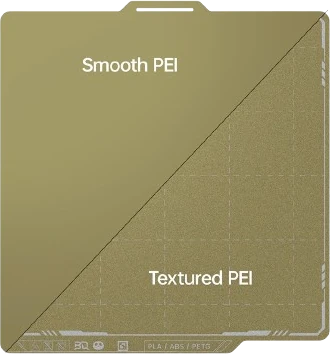

BIQU PyroGrip (left) and CryoGrip Pro Frostbite (right), not to scale against each other. Images: BIQU (product images).
Short version
Both plates fit the Bambu printers with a 256 mm plate (A1, P1P, P1S, P2S, X1C, X1E, X2D) and do opposite jobs. The BIQU PyroGrip is double-sided textured PEI like Bambu's Textured PEI Plate, and BIQU lists PLA, PETG, TPU and ABS for it: buy it as a spare everyday plate. The BIQU CryoGrip Pro Frostbite is a coated cold plateA build plate with a sticky coating that holds PLA and PETG at bed temperatures well below normal PEI settings. for PLA and PETG only, with a grip owners and Tom's Hardware describe as extreme. Add it only if warping PLA, or having to print PLA with the door open, is the problem you want to fix, and expect thin parts that are hard to remove, glossy bottoms, and no alcohol: BIQU warns it can permanently damage the surface.
Double-sided textured PEI on spring steel. Use it like Bambu's textured plate; on the P2S and X2D, BIQU says to turn off build plate detection.
View on Amazon
Coated cold plate for PLA and PETG only. Soap and water only, no alcohol, no TPU. Same detection note for the P2S and X2D.
View on AmazonAffiliate links. We may earn a commission at no extra cost to you.
Who each plate is for
BIQU PyroGrip
- Surface PEI, textured on both sides
- Rated for PLA, PETG, TPU, ABS
- PLA bed 45-65°C (Bambu PEI range)
- Cleaning dish soap and water
- Bottom finish matte, textured
CryoGrip Pro Frostbite
- Surface coated, both sides
- Rated for PLA and PETG only
- PLA bed 30-50°C (BIQU)
- Cleaning soap and water only
- Bottom finish glossy (owners)
PyroGrip for every day, Frostbite for one job
Pick the PyroGrip for a second plate that works like Bambu's textured plate, so you can start the next print while a part cools. Pick the Frostbite if you print mostly PLA or PETG and your problem is lifted corners, small parts that pop loose, or an enclosed printer you have to open for PLA (it can stay shut only with the bed at 45°C or less), and you can live without alcohol, TPU and a metal scraper, with patience for thin parts.
What owners report: CryoGrip Pro Frostbite
Strengths
- Grip at low bed temperatures. Tom's Hardware named it the best cold-grip plate in its May 2025 roundup, tested on printers including Bambu's P1P, A1 and A1 mini, and called it almost too sticky. Dextera prints PLA at 35°C and PETG at 45°C and reports that both stick perfectly, including small PLA parts and sharp corners that failed on Bambu's textured plate.
- The door can stay shut for PLA, at the low end. Bambu's filament guide recommends opening the front door or removing the top glass for PLA when the bed is set above 45°C, so the chamber does not soften the filament. Only the lower part of BIQU's 30-50°C PLA range stays at or under that line; Dextera, at 35°C, has not opened the door or lid once since switching.
- It can last. keaton.jt reports more than 1,600 hours on one Frostbite, mostly PETG, with adhesion still strong; cryptonym calls it very durable if you keep the bed temperature down and never use alcohol.
Weaknesses
- Thin parts, brims and purge linesThe thin line the printer draws at the edge of the plate before each print to prime the nozzle. are the most common complaint. Freer writes that anything under three layers tall may be a hassle to remove, though a plastic scraper or a careful fingernail is all it takes; Wahrheitssager69 finds small models with supports or a brim really hard to get off, and BIQU's own listing advises against a brim.
- Glossy bottoms. user_1372350327 says the Frostbite makes even matte PLA super-shiny; E35lab describes a paint- or varnish-like texture. If you want the PEI texture on your parts, this is not the plate.
- Running it hot backfires. Freer warns that PLA at 65°C will print, but the coating can come off with the part; a wood PLA user who kept his textured-plate temperatures was left with a patch where nothing sticks anymore. On his A1, ArtyP sees more elephant's footA first layer that bulges outward because it was squashed too flat or stayed too soft. on the Frostbite than on the stock PEI plate at a 65°C bed, which he calls on the higher side; he does not say which filament, and 65°C is well above BIQU's PLA range and near the top of its PETG range. He suspects Bambu Studio's default Z offset, but both replies in his thread question the bed temperature first, and one suggests dropping to 50°C.
- Lighter sheet, mixed PETG results. Tbenker found it lighter than Bambu's PEI plate, and semixhalf reports that full-plate PETG prints bend the whole plate and loosen its hold on the magnetic bed. On PETG, Bull calls large parts a warping nightmare on his P1S and X1C; Dextera reports no trouble at 45-50°C.
What owners report: BIQU PyroGrip
In the Bambu forum the PyroGrip comes up in only a handful of threads, almost all about the H2-size plate; we found no owner report there specific to the 257 mm plate, and no independent test of it. What there is points to plain textured PEI.
- A little less grip than Bambu's current plate. maxim3D, who owns the H2 version, calls it a regular PEI plate without a coating, with less grip than Bambu's newer coated textured plate; that is why he uses it for soft TPU (90A and 85A) and PEBA, which come right off without glue as a release layer. He also uses it for PETG at times.
- Texture. E35lab (H2S) finds it similar to Bambu's PEI plate but even grainier.
- Wear. dann2707 reports that the etched BIQU logo in the middle of his H2-size plate peeled off after a couple of months and now shows in his prints.
Fit and settings on Bambu printers
Both plates are sold as 257 × 257 mm, the class Bambu calls 256 × 256 mm; Bambu's plate overview and both BIQU listings name the same printers for it.
| Printer | Plate size (Bambu) | PyroGrip and Frostbite 257 mm | What to know |
|---|---|---|---|
| A1, P1P, P1S | 256 × 256 mm | Fits | Select the plate type in Bambu Studio yourself. |
| X1C, X1E | 256 × 256 mm | Fits | BIQU says the Frostbite carries a code for X1C recognition; its PyroGrip store page (titled for the H2-size plate) mentions one for the X1 series. If the printer cannot see the plate marker, Bambu tells third-party plate users to ignore the message. |
| P2S, X2D | 256 × 256 mm | Fits, detection off | Turn off build plate detection or tap Resolved (see below). |
| A1 mini | 180 × 180 mm | Does not fit | BIQU sells a separate size. |
| H2 series, A2L | 350 × 320 mm (H2D, H2S), 330 × 320 mm (H2C, A2L) | Does not fit | BIQU sells separate sizes. |
Plate detection on the P2S and X2D
The P2S and X2D use the camera to check that the plate on the bed matches the slicer file, pause the print when it does not (Bambu wiki), and recognize only Bambu's second-generation plate codes. Both BIQU listings say to turn the detection off on these two printers. Bambu's own advice for an unrecognized plate is to tap Resolved or turn off build plate detection; on its SuperTack store page Bambu gives the path as Settings, Print Options, "Enable the detection of build plate position". To keep the check on, MakerWorld has printable code clips that snap onto the plate and make a P2S or X2D read the Frostbite as a cool or smooth plate, for example this clip.
Settings: PyroGrip
Treat it like Bambu's textured plate: select Textured PEI Plate in Bambu Studio and stay inside Bambu's ranges for that plate (FIG.2). BIQU's store page gives PLA 60-65°C, PETG 70-80°C and ABS/ASA 90-100°C, within those ranges, but read it with care: it is titled for the H2-size plate while listing 256 mm specifications. For PC, PA, ABS and ASA, Bambu notes that textured PEI may need a thin layer of glue stick, and it recommends letting the plate cool to 35°C or lower before you flex parts off. BIQU's Amazon listing gives no cleaning instructions, so follow Bambu's textured PEI cleaning guide: warm water and a dish soap without oils or moisturizers rather than alcohol, never acetone.
Settings: Frostbite
- Plate type. Most owners select Cool Plate SuperTack in Bambu Studio, among them Vince2000 and user_3454396445. BitingChaos warns that Textured PEI Plate sets temperatures too high for the plate and changes the Z offset through Bambu Studio's start G-code. A few owners pick it on purpose (Ukoyries says it fixed his first layers); if you do, set the bed temperature by hand.
- Bed temperature. Owners often run below BIQU's upper limits (FIG.2): Dextera uses 35°C for PLA and 45°C for PETG, Freer 40°C and 60°C, while hyiger recommends about 50°C and 65°C. Quietman advises starting around 35°C, since at 30°C or below adhesion depends on the room temperature.
- Removal and adhesives. Let the part cool, flex the plate, and use a plastic scraper or a fingernail on thin parts; Freer says to throw away the metal scraper. maxim3D adds that the Frostbite is not meant for adhesives such as Magigoo.
Alcohol: follow the Frostbite's own listing
BIQU's Amazon listing for the Frostbite says water and soap only and warns that alcohol and other solvents can cause permanent surface damage. The line on BIQU's store page that a wipe with soap or alcohol restores adhesion describes the Glacier, which shares the page. If you wipe plates with isopropyl alcohol before every print, that habit has to go.
Alternatives
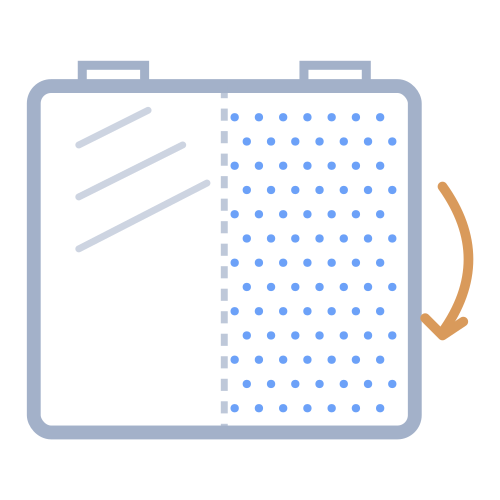
UniTak3D Double-Sided PEI 257 mm. Smooth PEI on one side, textured on the other, for the same printers. PETG grips smooth PEI hard enough to need glue as a release layer.
Affiliate link. We may earn a commission at no extra cost to you.
- Bambu Cool Plate SuperTack. Bambu's own cold plate, with care rules that match BIQU's: PLA and PETG only, no TPU, no organic solvents such as acetone (Bambu wiki). user_1372350327 finds the SuperTack Pro as sticky as the Frostbite, with flat, matte bottoms, and FraserNoble finds the SuperTack better and easier to release. The P2S and X2D recognize only the newer version; one buyer received the old version in August 2026, so check what you get. SuperTack in the Bambu store
- Bambu Textured PEI Plate. The same surface with Bambu's plate codes and, per forum regulars, a newer coating that grips harder than plain PEI; the simpler spare if P2S or X2D plate detection matters, since those printers recognize only its second generation. Textured PEI Plate in the Bambu store
- BIQU CryoGrip Pro Glacier. The Frostbite's finer-textured sibling, which BIQU rates for all materials printed below 300°C nozzle temperature and allows alcohol on. For PLA, ModelThreeve finds the Frostbite much better unless you want the finer texture.
The Bambu store links are plain links; we earn nothing from them.
Common questions
Can I clean the CryoGrip Frostbite with isopropyl alcohol?
No: BIQU's Amazon listing for the Frostbite allows only water and soap and warns that alcohol and other solvents can permanently damage the surface.
Can I print TPU on the PyroGrip or the Frostbite?
Yes on the PyroGrip, which BIQU lists for TPU. No on the Frostbite: BIQU rates it for PLA and PETG only.
Sources: BIQU Amazon listings for the PyroGrip 257 mm (ASIN B0D2R8JSQM) and the CryoGrip Pro Frostbite 257 mm (ASIN B0DPL5Z6TS), checked October 8, 2026 · BIQU store, PyroGrip · BIQU store, CryoGrip Pro (Frostbite and Glacier) · BIQU's Frostbite and Glacier comparison, via MatterHackers · Bambu Lab Wiki, build plates · Bambu Lab Wiki, Cool Plate SuperTack · Bambu Lab Wiki, Textured PEI cleaning guide · Bambu Lab Wiki, filament guide and plate temperatures · Bambu Lab Wiki, P2S intelligent detection · Bambu Lab Wiki, X1 build plate marker message · Bambu store, Cool Plate SuperTack (detection path) · Tom's Hardware, Best Build Plates for 3D Printers (May 9, 2025) · Bambu forum threads 102256, 100363, 148160, 214663, 228745, 254247, 236566, 255268, 238925, 253332, 253102, 207566, 257712, 204784, 193470 · MakerWorld code clip 2574789. Figures are our own drawings from these sources.